Showing posts with label review. Show all posts

Monday, 27 January 2014

neo-fascism and neo-corporatism: The Emergence of the Cartel Party

Régime censitaire is an interesting phrase: cens was a fee paid to a feudal lord which sometimes accorded voting rights. Thus the régime censitaire refers, in Peter Mair’s and Richard Katz’ seminal 1995 article Changing Models of Party Organization and Party Democracy: The Emergence of the Cartel Party, to the state of democracy in the late 19th century, where some degree of property ownership was necessary in order to vote.

The "cartel party" refers to a situation where major parties compete for an electorate’s votes with none offering anything qualitatively different from the other, therefore they gain more from cooperating with each other than competing, to democracy’s cost. (Hobbling the free press, anyone?)

Parties evolve from "caucus" entities representing the minority entitled to vote to “mass parties” upon universal suffrage, then "catch-all" parties offering all things to all people, little different from each other. Here the titular cartel starts to form.

Scarily, Mair and Katz note that other bodies such as trade unions and employers’ associations "[develop] relationships with the state that are not unlike those developed by the parties themselves" – I would add developers and the diversity industry. They call this "neocorporatism". I have to wonder if they were referring to a quote by Mussolini, "Fascism should more properly be called corporatism because it is the merger of state and corporate power". Is neo-fascism the corollary of neo-corporatism?

There is hope: new parties can challenge the cosy huddle, but must resist the trap the Liberal Democrats (identified by the authors) have fallen into of joining "the establishment they once decried".

Mass parties on either side of the pond produced Churchill, Attlee and Thatcher, and FDR, JFK and the Bushes before political cartels reincarnated the régime censitaire by restricting power within the circle of those who possess it already.

My money’s on UKIP and the Tea Party to shake things up. How about yours?

Gerry Dorrian
300 words

Resources

Changing Models of Party Organization and Party Democracy: The Emergence of the Cartel Party - Richard S. Katz and Peter Mair, originally from Party Politics

(Leveson deal: MPs debate press legislation: as it happens - Rowena Mason, Daily Telegraph, 18 March 2013

"Mussolini on the Corporate state - Political Research Associates

Click for reviews of Ruling the Void: The Hollowing of Western Democracy, in which Mair's ideas on the political cartel arising from the article reviewed were posthumously developed from his notes

click for a review of The Triumph of the Political Class, in which Peter Oborne continues on Mair's ideas in Ruling the Void

Monday, 13 January 2014

CJ Sansom's "Dominion": a low punch at UKIP

click for reviews on amazon.co.uk

It’s now widely accepted that Winston Churchill had a "wobble" in his now-famous three days in May 1940 when he was occupied by the feasibility of negotiating a peace with Hitler’s Germany after the "Narvik Debate" on the disastrous Norwegian campaign brought down Neville Chamberlain’s Conservative government and Churchill came to lead a tripartite National Government.

In CJ Sansom’s alternative history novel set in 1952, Dominion, Churchill was rejected in favour of Lord Halifax as leader of the Tories. Following the Dunkirk evacuation, a crisis in Parliament led to those peace negotiations with the Nazis, and Great Britain became effectively a German vassal state under the leadership of Lord Beaverbrook.

I don’t agree with Sansom’s intimations in the novel that patriotism is by nature evil. Nevertheless, taking something you normally wouldn’t pick up and turning it into something you can’t put down is the mark of a great writer.

What worried me is that, after the end of the novel, Sansom presents an essay on his views on Nazism, nationalism and patriotism in general (which, in conjunction with Palestine – ie Israel – he cites as the two great blights of the real postwar world). At the end of the essay, in which Nazism and fascism are extensively mentioned, he opines that UKIP is another manifestation of the "blight" of patriotism.

He offers no opinion on the EU which, although not a national or nationalist entity, many would point to as non-violent fascism. By the time he comes to UKIP, after pages spent railing against fascism and associating patriotism therewith, the footnotes have dried up, but the intention seems to give the reader the idea s/he is reading an academic essay condemning UKIP.

Should we be asking Macmillan whether, should it reprint Dominion before the 2015 General Election, it will reprint Sansom's tendentious essay?

Gerry Dorrian
300 words

Resources

Three Days in May: When Winston Churchill wobbled - Jasper Rees, Telegraph

Conduct of the War Hansard minutes of House of Commons debate of May 8 1940, also called the Norwegian Debate/Narvik Debate

Click to read reviews of Dominion at Amazon

Pan Macmillan (publishers of Dominion) contact page

Monday, 18 November 2013

it's time to let JFK rest in peace

click for All about History website

All about History is, for my money, the best of the new arrivals in the burgeoning history magazine market, and this month they haven’t skimped on marking the 50th anniversary of John F Kennedy’s assassination. There’s not only an account of the assassination but an assessment of Kennedy’s achievements and legacy, plus a review of assassinations through history. It’s all good reading, and conspiracies are left to rest in peace.

November’s History Today, the best of the established magazines, counted JFK among its subscribers. Peter Ling, in Killing Kennedy: Cock Ups and Cover Ups, assures readers that this was the reason behind his assassination, before going on to chronicle a catalogue of failings by investigators that would have shocked those who had birthed forensic science decades before.

This is the 50th anniversary, and historians generally agree that it marks Camelot’s sad end passing from current affairs into history. Sharing that view is Colin McLaren, who has been sucked into the Deeley Plaza industry as have many before him. In the Channel 5 documentary JFK’s Secret Killer: The Evidence he brings into the frame George Hickey, who many people, myself, have never heard of before.

When I saw JFK’s Secret Killer I thought, "that’s it!" McLaren’s theory explains the many enduring contradictions and explains cover ups of the sort that, according to Jesse Ventura, breed conspiracy theories. What is most elegant is that he leaves room for what Karl Popper – in Conjectures and Hypotheses – are the marks of authentic theories: unintended consequences.

Then I discussed the programme with a friend who’d served in the forces and had experience with weapons similar to those mentioned and with how bullets behave, and who was not impressed with this or any other theory.

In the end I agree with one thing McLaren says: it’s time to close the door on this assassination. Let’s let the man and his brief shining moment rest in peace.

Gerry Dorrian
300 words

Resources

All about History

Killing Kennedy: Cock-Ups and Cover Ups - Peter Ling, History Today, November 2013

JFK's Secret Killer: The Evidence Channel 5 - available until 10 December 2013

JFK conspiracy theories abound, despite a lack of evidence - Scott K. Parks, Dallas News, 17 November 2013

Wednesday, 13 November 2013

Curtain - Poirot's Last Case

thanks to David Suchet and ITV
One of the best aspects for me of Hercule Poirot’s apparently needing a wheelchair in ITV’s Curtain – Poirot’s Last Case is that although he is invalid, in the language of the time and for decades afterwards, he is in no way in-valid. His is the obstinate anger of the person who knows his worth, and what’s more of the disabled person who refuses to be perpetually grateful evidence of others’ forebearance and charity.

The issue of invalidity is key to this mystery which, Agatha Christie biographer Laura Thompson tells us, was written in 1940 while Christie was working in a central London hospital during the Blitz. It was by no means certain at that point that Great Britain would be on the war’s winning side, and the Nazis’ ideology of Übermensch and Untermensch come through in a dinner conversation about "unfit lives" and euthanasia, just as the national conversation about whether Hitler was a Good Thing or not would make it into Dorothy L Sayers’ work earlier, when British people at all levels of society were split down the middle on the matter.

Unlike other commentators I see no need to cast aspersion on other screen Poirots in order to praise David Suchet’s definitive interpretation. Albert Finney and Peter Ustinov were exquisite Poirots, and Suchet takes the material and elevates it to those heights of high art that excluded the novels on the grounds that they were readable, ie not literary. With Curtain, Christie gives us literary Poirot and Suchet rises to the challenge wonderfully. We’re still reading Christie almost a century since she started writing, and our descendants also still be watching Suchet’s Poirot a century hence, when it will feel as if it was made for them just as it feels Christie wrote for us.

Gerry Dorrian
300 words

What made Hercule Poirot perfect - Laura Thompson, The Telegraph, 13 November 2013

Click to read reviews for Agatha Christie: An English Mystery by Laura Thompson

Agatha Christie's Poirot on ITV Player

Read more about David Suchet and Poirot at david-suchet.ru

Monday, 4 November 2013

A Life Steered

'A life Steered': go to Amazon
I ordered A Life Steered after reading a review of it on author Bertha Mukodzani’s blog by Deswell Chitewe, who champions Zimbabwean authors.

A Life Steered begins with a distressing scene in which the main character’s hard-drinking father finally throws her mother out of the house after many fights. From such a beginning I could not have imagined that the novel would go on to be an uplifiting testament to the strength of the human spirit - demonstrating that while our beginnings are always with us, the wings of our hopes await.

The travails of Zimbabwe are expertly understated through the course of the action and are braided with signposts non-Zimbabweans will be able to orientate themselves by. Not that you need to be from Zimbabwe to appreciate A Life Steered: when you focus down on a small group of people and look at the different ways they choose to overcome their obstacles, you never fail to find the universal interplay of suffering and hope, and which one triumphs is often due more to how people approach them than to random interventions of fate.

click to go to Bertha's website
What struck me particularly is that A Life Steered is set at a time when girls and young women were looking beyond the traditional lot of females in Zimbabwean society, not least the complex politics of polygamy which, whenever that practice arises, seems to favour men. Heroine Sandra’s glass ceilings come not from corporate structures, but the society Bertha describes so lovingly and with such humour. In the UK I don't think we've been totally successful in maintaining what was best about our traditions while we removed our glass ceilings, and would be interested to hear what Bertha thinks. Perhaps food for a future novel?

A Life Steered is Bertha Mukodzani’s (right) first novel, and I was gratified to read on her blog that another one is in the pipeline. I look forward to following her career and to collecting her works.

Gerry Dorrian
300 words

Resources

Read reviews of A Life Steered on amazon

Bertha Mukodzani's homepage

Deswell Chitewe reviews A Life Steered on Bertha's blog

an excerpt from Bertha's second novel

Monday, 28 October 2013

Quitting the English Defence League: when Tommy met Mo

click to watch on I-player

Quitting the English Defence League: when Tommy met Mo is a documentary about Tommy Robinson’s move into Quilliam, the anti-extremism group.

Since it was a BBC documentary I had low hopes for imparitality, so was dumbfounded to see Tommy his views freely throughout.

The journey – the term speaks volumes about I’m a Celebrity’s impact on broadcasting – started in the company of Mo Ansar, who once agitated for the EDL to be banned. Ansar’s diversionary tactics on explosive Koran texts, such as cutting off the hands of thieves, being shot down by two eminent Koran scholars was amazing TV.

Maajid Nawaz: click to learn more
One of these scholars is Maajid Nawaz (right) of Quilliam who, like Tommy, receives multiple death threats. He and his companion supported Tommy against Ansar in that the phrase "all your right hands possess" from the Koran refers to concubinage, including sex slaves.

Through Nawaz, Robinson spoke to a group of Muslim women who proved as heterodox as any group from any religion. While Ansar was the first in the documentary to speak of “reformed Muslims”, but it was the Koran scholars who gave the notion legs by identifying the disconnect between scriptures over a thousand years old and a pluralist, liberal society where everybody has rights, including people like homosexuals who are executed in Iran.

As Tommy identified, we need to ensure that moderate Muslims, who are indicted as apostates by jihadis who can justify their judgement from the Koran and Sharia, are heard. So, I wonder, after future jihadi outrages, will the BBC and other channels continue to give extremists like Anjem Choudary a voice in the name of impartiality? Or will it eschew extremists and air the views of ordinary Muslims as oppressed by jihad as us? It seems Tommy’s not the only one at a crossroads.

Gerry Dorrian
300 words

Resources

Quitting the English Defence League: when Tommy met Mo - bbc I-player until 4 November 2013

Quilliam

"The Government should ban the EDL - HM Government e-petition, created by Mohammed Ansar (closed with 6,448 signatures)

BBC, ITV and Channel 4 face Ofcom probe over decision to interview hate preacher Anjem Choudary after Lee Rigby's murder - Daily Mail

Surat An-Nisā' Sura 4 of the Koran (Surat An-Nisā or The Wonen), mentions "all your right hands possess" severalk times.

Friday, 25 October 2013

The Crime of Father Amaro

Eça de Queirós: red more at Britannica

The Crime of Father Amaro, by José Maria de Eça de Queiroz (right), was translated magisterially by Margaret Jull Costa from the 1880 edition, released at the end of a complicated publication history.

The tale of a priest seducing a woman was highly controversial in Catholic Portugal, but unfortunately sounds pedestrian today.

Eça de Queiroz presents no glib jibes or caricatures. The titular priest was himself presumed by relatives to be seminary fodder and only realised once there that he had sleepwalked into a profession which precluded marriage. He typifies, in Eça de Queiroz’ words, "the man eternally excluded from feminine dreams, the neutral, melancholy creature who prowls the shores of sentiment like a suspicious intruder" and in his innocence can’t believe his luck when he and the prettiest girl in the village – Amélia, herself kept naïve by institutions that allow no middle ground between virgin and whore – develop a neotenous adolescent crush.

The emotional coin of adolescence has limited currency in adult bodies, but Eça de Queiroz treats Amaro’s struggles with compassion and insight.

Up to a point.

The point is where Amélia’s fiancée drunkenly assaults Amaro, having divined his intentions towards her. His punch is ineffective, but the priest colludes with the community in painting João as a heretical thug and driving him out. Just as Aeneas is no longer heroic after ignoring the gods with his naturalistic marriage to Dido, so Amaro’s heretofore juvenile blunderings no longer power a comedic tale with a tragic core. The polarity gradually changes until it seems tragedy must suffocate comedy in its inexorable momentum towards a horrific outcome.

The turbulent political backdrop was but a prologue to the next bloodsoaked century; but for me the operative part of Amaro was the emotionally and morally stunting effects of compulsory priestly celibacy, which continues to produce tragedies from the same template.

Gerry Dorrian
300 words

Wednesday, 2 October 2013

Tom Clancy RIP

Tom Clancy: click to learn more
Much of the comment upon Tom Clancy’s sad death seems to centre around, as the Telegraph puts it, his "gung-ho techno-military thrillers".

However, my own favourite among his thrillers was The Sum of All Fears, which tells the very human story of his serial hero, Jack Ryan, slipping into depression and alcohol addiction as his dream of a lasting peace in the Middle East is sabotaged by extemist Palestinian elements. (That the villains in the film were neo-Nazis shows the extent to which Hollywood, once having slavered at Hitler’s door, now protects his successors.) Clancy is often criticised for his "two-dimensional" characters and seems to hit back in this book with the character of Marvin Russell, a Native American psychopath – a swipe at shibboleths? – who is killed precisely because he is two-dimensional: in the words of his executioner, "there was something missing in this man".

Executive Orders, featuring Ryan as president, starts with a devastating 50-page character study of one of the few people qualified to do politics: one who didn’t want the job.

The death of an artist at the height of his powers guarantees his next work’s sales. Command Authority is expected to be a not-to-veiled analysis of Russian president Vladimir Putin’s past in the Cold War; a war which, he observed through his works chronicling its endplay and aftermath, elevated many but left many more broken.

It’s not clear that Clancy’s departure must needs be that of Jack Ryan and his "dark side" John Clark, but it’s difficult to see who could handle the characters with equal skill. In any case, one of Clancy’s quotes on writing comes back to me as his home country, with its federal government shut down, slides from tragedy into farce: “the difference between real life and fiction is that fiction has to make sense”.

Gerry Dorrian
300 words

Tuesday, 17 September 2013

Britain's Broken Families

After watching the BBC’s Britain’s Broken Families follow the progress of Newcastle’s Family Intervention Project, I wondered which was more broken: the families or the system?

One of the two cases caught my attention in particular. Sharon, who has mental health problems, is mother to Sian, a 14-year-old girl who has not attended school for a year. She is in a sexual relationship with a 16-year-old boy, one of several teenagers who come regularly to the flat and cause chaos for Sharon’s neighbours.

Where to start? When education heroine Malala Yousefzai rightly spoke to the UN about the value of education accompanied by Gordon Brown, did Brown inform her about educational non-uptake in the UK? Would she not agree that denial of education is child abuse?

Who are these teenagers infesting Sian’s room? Is Sian being pressured to provide more than floor-space?

Towards the end of the program, we find that the plans starting to bear fruit for Sian are thrown up in the air because she is pregnant, presumably by the 16-year-old. She is now awaiting to see if a social-worker will allow her to keep the baby.

click to view Fraser guidelines
Take a bow Lord Fraser, of the eponymous guidelines; these laid down that children can make their own decisions about medical treatment. His guidelines were specifically introduced after Victoria Gillick (right) stood up for parents’ rights and duties regarding child protection, specifically in sexual matters, and was rounded upon by the entire liberal-socialist Establishment.

Another worker voiced the wish that children not go into care. I understand that: the care system has for some time been infiltrated both by child-abusers and by managers who seem not to believe that child-abuse is always wrong.

And caught in the infernal web of liberal intentions are Sian, her mother, and now her baby.

Gerry Dorrian
300 words

Resources

Click here to watch Britain's Broken Families on i-player until 23 September 2013

Britain's Broken Families webpage

Gordon Brown: Malala's UN speech is just the beginning - cnn.com

Fraser Guidelines - GP notebook

1983: mother loses contraception test case - BBC on this day

Monday, 9 September 2013

Blackout

watch blackout on 4oD

Pace Cloverfield and Paranormal Activity, Channel 4’s Blackout is the best found-footage film I’ve seen, and all the more scary because of its feasibility.

The last blackouts to affect Great Britain were in 1972, during the Miners’ Strike. They were only in the evenings, but memories were still strong enough to see Edward Heath’s government voted out when he called an election over the strikes in 1974.

In Blackout the outage lasts for a week, literally 24/7, and by day 2 social order is breaking down. For me the central character is a DIY enthusiast who borders on what in the US would be called a "prepper", an individual who stocks food and supplies in case of an emergency entailing social breakdown. What our man seems to have overlooked is a stock of what across the Pond would be common sense: in such a breakdown you don’t just need supplies, you need the wherewithal to protect them.

Danse Macabre: clikc for reviews
In his non-fiction book Danse Macabre, horrormeister Stephen King concludes that horror films – and Blackout was very chilling – reflect the preoccupations of society at that time. Thus Them and the Godzilla movies reflected fears around nuclear warfare, while The Exorcist and The Omen came out at times of anxieties caused by youth uprisings.

I think King’s take on Blackout would be that it reflects, pretty obviously, fears about the fragility of our social fabric. However, King would also look at other meanings of the title: information blackout, say, as in the dearth of knowledge we have about how many people are actually in our country and how our money is really being spent at home and abroad; and blackout of consciousness, whereby our unelected establishment chooses not to be mindful of the abuses perpetrated by its favoured communities.

Watch Blackout – and be scared.

Gerry Dorrian
300 words

REsources

Watch Blackout on 4oD

Go to the Channel 4 homepage for Blackout

Monday, 26 August 2013

The Old Ways

If you’re travelling in an enclosed space like a bus, train or plane, then it’s all about you. You might as well sit still while the world turns about you.

Travelling on foot it all changes. Everything is about the other – the people you meet, the places you pass, the very consistency of the ground underneath. These form the warp and weft of your traveller’s tales.

click for reviews on Amazon
Robert MacFarlane’s traveller’s tales, recounted in The Old Ways, take him from Britain to Spain, Tibet and Israel as he explores how land builds people.

This would make an interesting book anyway, but what makes it unique is MacFarlane’s gift for not just communicating the texture of a moment but inviting the reader to join him inside that moment, be it traipsing barefoot in Scotland (where I empathised with his reticence to experience nettles as “chili for the feet”), being chosen by a book in the Library of the Forest in Madrid or accompanying an old friend in a melancholy meander over old Palestinian pathways. As a recovering twitcher I was taken by his description of a rock dove as a “hoplite vicar”.

I was worried that MacFarlane would use his journeys in Palestine to make a political point, but my fears were unfounded. He tells the stories of his travels as if each journey were a precious jewel, and leaves the reader to draw his or her own conclusions.

Something that interested me in the section on Palestine was the story of a friend of his who narrowly being shot by militia on the grounds that "it is halal to kill the guilty English". The British (presumably what was meant) left the Palestinian Mandate in 1948. Perhaps food for thought given the decisions our politicians have to make about engagement in Syria?

Gerry Dorrian
300 words

Saturday, 24 August 2013

2666

In the fictional city of Santa Teresa in the real-life Mexican state of Sonora, women are being murdered. A man is convicted of the crimes and imprisoned. Women are still being murdered.

click to read reviews on Amazon
This is at the centre of Roberto Bolaño’s epic story-cycle, but to concentrate on it would be to miss what the late Chilean novelist’s editor Ignacio Echevarría calls, in his note to the first edition of the posthumously-published novel, its "hidden centre".

I believe an indication as to where that centre lies is furnished by Bolaño’s solicitude for those who slide off the page of history, for example the murdered women who work in Santa Teresa’s factories, who one blogger suggests are based on the real-life murdered women of Ciudad Juárez. On the way through the mammoth work we also meet a Harlem preacher extolling the salvific virtues of duck à l’orange and Voltaire, an Aryan maiden who rejects her father’s Nazi propaganda, and a Mexican policeman who rejects the macho venality of his colleagues and falls in love with the methodology of detection (called Lalo Cura; la locura is Spanish for madness).

click to view Arcimboldo's art
I hope I’ve given you an inkling of how wide-ranging 2666 is, although I’ve hardly scratched the surface. Bolaño treats space and time as rules made to be broken, and fact and fiction as relational opposites whose conjunction provides yet richer seams for him to mine. And one common seam is Benno Archimboldo, whom the author connects more than once with Giuseppe Arcimboldo, the artist who painted The Four Seasons (Winter - left) and The Four Elements. Archimboldo, I think, will join the pantheon of famous literary obscures beside such as John Galt and Ishmael.

I spent a long time reading 2666. Closing it for the last time felt like waving farewell to a friend. I thoroughly recommend it.

Gerry Dorrian
300 words

Thursday, 1 August 2013

Andrew Marr and communism's mutant sister

Andrew Marr is my kind of Liberal, in that he has insight into the fact that his outlook is merely one of several: it was he who first identified, in 2006, that the BBC had “an abnormally large number of young people, ethnic minorities and gay people” and suffered from a "cultural liberal bias".

You might object that there’s nothing wrong with being young and/or gay and I’d agree wholeheartedly. What Marr meant, I think, is that the BBC fails the diversity tick-box test by having so many more young and/or gay people than the communities it serves that it doesn’t reflect those communities accurately.

click for reviews for 'A History of Modern Britain'
He showed this insight again in his 2007 book A History of Modern Britain, where he praises the benefits of immigration. Then he makes the one point commentators may not raise: no politician ever asked the British populace for permission to open the floodgates.

click for reviews for 'A History of the World'So it’s disappointing that, in his 2012 tome, perhaps somewhat hubristically titled A History of the World, his ability to think outside of the culturally liberal box deserts him when it comes to comparing communism and fascism.

He’s not afraid to tackle the abuses of communism: he identifies Stalin as the world’s worst mass murderer, and again says something liberals shouldn’t: Stalin merely finished what Lenin started.

My beef is that he flees from identifying fascism as the other side of the same coin as communism, but instead identifies it as "communism’s mutant sister". He seems to be in thrall to the idea that fascism can only be right-wing – but how many right-wing dictators soiled the 20th century? Hitler nationalised most of Germany’s businesses and proclaimed himself an anti-capitalist, with Mussolini close behind. Franco was the only right-wing dictator. Isn't any totalitarian "supreme leader" a fascist?

Fascism isn’t the mutant sister of communism: it’s the identical twin.

Gerry Dorrian
300 words

Resources

We are biased, admit stars of BBC news - Daily Mail

REad reviews for A history of Modern Britain on Amazon

Read reviews for A history of the World on Amazon

What is fascism? A surprising BBC debate - 300 words

Hitler was a socialist (and not a right-winger) - Democratic Peace Blog

Monday, 29 July 2013

Wagner, Tolkien and the ring

click for the programme web page
Having recently conquered Lord of the Rings, I was interested to see during BBC Radio 3’s Ring Cycle marathon a short discussion entitled When Tolkien stole Wagner’s Ring.

Tolkien constructed his legendarium from pre-existing building-blocks, but it hadn’t occurred to me that he’d stolen it from anyone. And neither of the participants (professor Nick Groom and author Renée Vink) accused him of stealing. As Vink said, both Wagner and Tolkien mined the rich seam of Norse mythos.

Then, of course, there's Hitler, to whom Wagner – who died six years before Hitler’s birth – was attractive because of his atrocious anti-Semitism, unfortunately all too prevalent throughout the West.

Shiva as Nataraja: click to learn more
But the ring theme predates Norse legend. Perhaps indicative of Europe's ancient Eastern roots, since antiquity the Hindu god Shiva has been depicted dancing within a ring of fire (left), and both our artists associate their respective rings with fire – Wagner’s with his fire encircling Brünnhilde in Die Walküre as she sleeps on the mountaintop, Tolkien’s with the fires of Mount Doom in which Sauron’s Ring of Power must be destroyed.

Tolkien’s work, however, is more rooted in the time of writing than Wagner’s. Written during World War II, the crisis in Middle Earth has come about through its peoples ignoring the rising powers of evil taking hold: a comment on appeasement? Groom recounts a contemporaneous letter referring to "that ruddy little ignoramus Adolf Hitler" misappropriating the traditions that had informed the character of his beloved England.

But although Tolkien, as a Professor of Anglo-Saxon, used his knowledge of northern folklore in writing LOTR, I think it’s significant that the name of the reforged sword (another shared theme) is Andúril, meaning Flame of the West. I hope Western patriots adopt his legendarium, telling of diverse peoples cooperating to fight against evil, as a founding myth.

So when will we see the first LOTR opera?

Gerry Dorrian
300 words

Resources

Twenty Minutes: When Tolkien stole Wagner's Ring BBC Radio 3 Proms - available until 2 August 2013

REad a review of Renée Vink's Wagner and tolkien: Mythmakers at Tolkien Library

The Letters of JRR Tolkien - use table of contents at the front for the hyperlink to Letter 45, which speaks of "that ruddy little ignoramus Adolf Hitler

Shiva in the form of Nataraja (dancing in a ring of fire) - Exotic India

Tolkien and the black riders - 300 words

Wednesday, 29 May 2013

don't dismiss Anonymous, their hands are dripping with blood

Reading about the Peasant’s Revolt, in which society flew apart under punitive taxation to pay for cronyism and wars, what struck me was how much historians’ access to events of June 1381 is hampered not by distance, but the deliberate muddling of contemporaneous records.

Rosa Parks: click to read more
In the age of mass media you don’t need to torch the Savoy to make a point. Considering that in 1955 Rosa Parkes (right) needed only not to rise from her seat to start a cultural revolution that’s still rolling, the fecundity of Gunner Lee Rigby’s martyred blood becomes comprehensible.

You wouldn’t think it to look at the mainstream media, though; press gagging orders seem to be doing the same job Revolt chronicler Thomas Walsingham achieved with misinformation. How else to explain the silence on how the Metropolitan Police forced an unrelated Sikh protest (about Professor Bhullar) between an EDL protest and the UAF counter-protest?

So I don’t believe "hacktivists" Anonymous’ entry is a coincidence. Styling themselves as hidden masters, they say that they’ll target the EDL for trying to segregate Muslims. I wonder if reactionary Establishment forces have brought them in to erase online mentions of our policy of peaceful protest in pursuit of multiculturalism and integration?

Just look at the logo at the end of their message to the EDL:

click for Anonmous' Message to the EDL

Anonymous and its partners, Lulszec and Wikileaks, are dripping in blood through their manipulation of Arab Spring conflicts. The death-tolls in just two countries affected are 70,000 in Syria, 30,000 in Libya.

Anonymous live by Stalin’s dictum that "one death is a tragedy, one million a statistic". But I hope anybody opposing us who finds a hit-list (because that’s what Anonymous are talking about) in their hand ponders the words of another era's revolutionary, Oliver Cromwell: "I beseech you, in the bowels of Christ, think it possible that you may be mistaken", then researches us while materials are still available.

Gerry Dorrian
300 words

Resources

Sitting Down: the story of Rosa Parks

Sikhs protest for Prof Bhullar, crossfire cleared up by the EDL:

Who Is Devinder Pal Singh Bhullar? - India Real Time

Anonymous' Message to EDL:

Syria death toll probably at 70,000, U.N. human rights official says - CNN

Libya death toll hits 30,000" - Mirror

"our minds and consciousness consumed by current scenes in Tunisia, Egypt and Libya" - AnonNews - Everything Anonymous

Click for a review of The Peasants' Revolt: England's Failed Revolution on amazon.co.uk

Thursday, 23 May 2013

Dispatches: The Hunt for Britain's Sex Gangs

The latest Dispatches documentary, The Hunt for Britain’s Sex Gangs, was always going to be hard-hitting. The fact it was broadcast when the nation was reeling from the brutal murder of soldier Lee Rigby by Islamists in Woolwich made it doubly so.

What enraged me was the cynical methods paedophiles’ defence lawyers use to terrify victims into incoherence: one police officer spoke of these vulnerable, abused girls being "retraumatised, revictimised and violated" in court. I’m sure she was speaking advisedly – one girl spoke of cross-examination as like being raped again.

Charlene Downes: read more at bbc.co.uk
Another police officer spoke of the danger of being perceived to be racist, when all he wanted to do was to put predatory paedophiles in jail. Putting aside the fact that there’s no such thing as race, it was obvious that the rapists were of shared ethnicity. Not every abuser is a Muslim and not every Muslim is an abuser; nevertheless, as senior police officials recover from fits of cultural sensitivity like that which scuppered the trial of Charlene Downes’ (right) groomers and killers, arrests for trafficking (which can result in more convictions than rape as it takes distorted issues surrounding consent out of the question) are soaring. The Office of the Children’s Commissioner has estimated that up to 10,000 children in Britain may be affected by sexual exploitation by gangs and groups.

And where those gangs and groups are street-based, chances are that they will be composed predominantly, if not exclusively, of Muslims. I don’t want to vilify people on account of their ethnicity or religion, I merely want children to be free to have a childhood. And, as English Defence League founder Tommy Robinson has said, Muslims are free to take to the street to point the finger at their co-religionists who rape children and kill soldiers. And say, “not in my name”.

Gerry Dorrian
300 words

Resources

Dispatches: The Hunt for Britain's Sex Gangs webpage

Inquiry into Child Sexual Exploitation in Gangs and Groups (CSEGG) - The Children's Commissioner for England

Watch The Hunt for Britain's Sex Gangs on 4oD

Watch Tommy Robinson speak on the Woolwich terrorist attacks, the EDL's response and other issues below, or click here to view on YouTube.

Click for English Defence League website

Saturday, 27 April 2013

The Joy of Easy Listening: what you hear is what you get

click to go to Richard Clayderman's website
BBC Four’s The Joy of Easy Listening was a welcome repeat. From Percy Faith to Adele and passing through Herb Alpert, the Carpenters and many more, it offered valuable historical and cultural insights into why and how this broad musical church developed from 1945 onwards. I was particularly glad to see Richard Clayderman, whose version of Let it Be in the early 1980s was my gateway to the Beatles.

The inclusion of Guardian journalist Paul Morley puzzled me, as his function seemed solely to voice the BBC’s cultural Tourette’s. He complained that easy listening music was "non-ironic"; Maybe he was thinking of the Beeb’s in-house definition of irony:

An ironic statement must appear as if you are sincere, [and] the line must be delivered straight, so that the recipient misses the hidden message but onlookers get it loud and clear.

Is it so insulting that with Easy Listening what you hear is what you get?

What really annoyed me was his comment that Easy Listening represented a parallel world where pop music is "non black" – shortly before the start of Easy Listening Hits at the BBC, which included Aretha Franklin, Johnny Mathis and The 5th Dimension, none of whom appear in the credits on the programme’s webpage. Is the implication that performing in a genre the BBC disapproves of abrogates black artistes' ethnicity?

The crack was probably a reference to the old saw that popular music was stolen from black people. The irony is that if any music was stolen from black people it is modern jazz, with rich and complex time signatures unheard of in the West until the 1940 Dennis-Roosevelt expedition to the Belgian Congo brought back and analysed recordings of music by Watusi, Batwa and Bahutu peoples, to name but three. Cue herds of privileged white BBC executives stampeding to justify their Dave Brubeck collections.

Gerry Dorrian
300 words

Resources

The Joy of Easy Listening BBC Four webpage

Easy Listening at the BBC BBC Four webpage

Irony h2g2 (BBC)

Denis-Roosevelt Expedition: The Belgian Congo Records of the Denis-Roosevelt Expedition Hip Wax (12th record down)

Sunday, 10 March 2013

smart drugs: Limitless?

Anna Friel: click for IMDB biography
Tonight Channel 4 showed Limitless with Bradley Cooper, Anna Friel and Robert de Niro. The film’s about a down-at-heel writer, Eddie Morra, who hasn’t managed to put a single word on a single page.

A former drug-dealer introduces Eddie to a new "smart drug", NZT-48, that changes the way he synthesizes disparate pieces of information while under its influence to produce insights and predictions people not on NZT can’t match. To cut a long story short, he overcomes his problems and by the end of the film has customised the drug to minimise the side-effects that has caused others to fall after sudden rises to fame, thus freeing himself from the need for a supplier.

click to read reviews on Amazon
It’s a story that would have warmed the hearts of those Enlightenment philosophes like Condorcet and Bentham who, in their different ways, believed humankind was endlessly improvable. Grumpier and more realistic individuals like Hume and Voltaire, however, would be more satisfied with the book on which the film is based. In Alan Glynn’s The Dark Fields, a sinister thread of growing conflict between the US and China is threaded through the book and, at the point of dying through withdrawals, the protagonist sees the US President on the TV, gorged on the drug, announce a war.

Smart drugs exist. Oxbridge Biotech argues that popping a pill to help you access more of your brain-power is no different from paying for private tutors. I disagree. Passing an exam - tutors or not - involves engaging your own mind and working hard to learn, because that is how to organically lay down neural connections that didn’t previously exist. The brain is the universe’s most complex machine, and boosting its performance with even the most smartly-engineered chemical is fraught with peril.

Where did I put that coffee?

Gerry Dorrian
300 words

Resources

Check out reviews for Limitless on Amazon.co.uk

Check out reviews of The Dark Fields by Alan Glynn on Amazon.co.uk Smart Drugs: Are you Tempted? - Oxford Biotech

Tuesday, 8 January 2013

targets and psychopaths

The Selfish Gene: read reviews at amazon
The Government is showing signs of softening public-sector targets, but the Establishment is so steeped in target culture it fails to see that targets themselves cause the problem.

Adoption of targets by politicians grew from Richard Dawkins' application of game theory to evolutionary biology in The Selfish Gene, where he proposes "evolutionary stable strategies" formed when individuals act as "doves" and "hawks" in various situations in order to maximise the gains to themselves by helping the community attain goals, eg get food or minimise conflict.

The Psychopath Test: read reviews at amazon
Hawks and doves are redolent of corporate carnivore Al Dunlop's "predator" and "prey" vocabulary when interviewed by Jon Ronson for The Psychopath Test. Ross discovers that there are proportionally more psychopaths in stratospheric management layers than in prisons. And as big money migrated to top public sector jobs, so damaged, damaging people followed it.

Adam Curtis’ documentary The Lonely Robot examines how target-setting based on game theory greatly excited politicians since The Selfish Gene appeared. Margaret Thatcher doubted the practice’s validity, but John Major took it up and Tony Blair embraced it. If you set targets for organisations and leave them to attain them however they choose, the theory goes, the best outcomes for everybody involved will result. In practice we got ambulances reclassified as hospital wards, trolleys as beds and "hello nurses" to satisfy Casualty admission targets: I would add that the whole sorry mess reached its nadir with the corporate massacre at Stafford in the name of targets.

Linda Mealey: go to her website
Linda Mealey (left) and Stuart Kinner write in Psychopathy, Machiavellianism and Theory of Mind that "psychopaths are 'designed' by natural selection to be…highly effective at securing resources through deception, force and social manipulation." Define resources as monopoly-money salaries, golden handshakes and funny-money pension pots and you have a picture of the upper echelons of our public services.

Gerry Dorrian
300 words

Resources

Click to read reviews of The Selfish Gene at amazon.co.uk

Read reviews of The Psychopath Test at amazon.co.uk

Watch The Lonely Robot below or click here to view on Youtube:

Read about The Social Brain: Evolution and Psychology (contains essay referred to in final paragraph)

Friday, 30 November 2012

11.22.63

check out 11.22.63 at Amazon.co.uk

11.22.63
Hodder
pp740

Check out 11.22.63 at Amazon

A novel centred on the assassination of John F Kennedy that was published the year before Barack Obama’s re-election campaign was always going to be controversial, especially when written by a Democrat who has compared right-wing "hate" towards Obama to the hate that culminated in Kennedy’s death on 22/11/63.

However, when the author is Stephen King, there’s always more to the tale – which is named after the above date, in American notation 11.22.63.

King mentions in passing in his time-travel epic that the "Tea-Party Society" sponsored leaflets promoting segregation: subsequent debate has historiann.com stating that this organisation was an invention of King’s, while a Daily Kos article identifies it with a shadowy Democrat splinter-group called the Dixiecrats. Was he inviting comparison with the Tea Party, or commenting on the complex skein of prejudices within which the Civil Rights Movement would shortly emerge?

Lee Harvey Oswald 'backyard photo', taken by wife Marina
He ponders whether a re-elected JFK would have turned Vietnam into the quagmire that Lyndon Johnson did, and emerges with an answer I hadn’t foreseen. In fact, as the story progresses the number of tantalising possible routes to denouement increases, with the author following the line of least predictability. But conspiracy-theorists rest easy: from Lee Harvey Oswald (left) to George de Mohrenschildt, the usual suspects are all there.

Enoch Powell
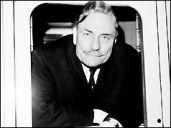
But what of a JFK who survives 11.22.63? King offers an interesting take on Enoch Powell’s (right) dictum – Obama-worshippers take note – that "all political careers, unless cut off in mid-stream, end in failure". Posterity blesses the beautiful, and for political beauty being young and doomed is sine qua non.

More than this, King offers meditations on the nature of love, of duty, and ultimately of reality itself that kept me coming back for more: once I started work bleary-eyed through reading instead of sleeping. I heartily recommend that you read 11.22.63 for the 40th anniversary of JFK’s date with cultural apotheosis.

Gerry Dorrian
300 words