Showing posts with label history. Show all posts

Thursday, 15 June 2017

"Brexit and Democracy": table of contents

Table of contents for Brexit and Democracy: Reclaiming full and equal suffrage from the political cartel:

Part 1: Antecedents of the European integration process

Chapter 1: Unity as foundational myth

Chapter 2: The Franco-Prussian War

Chapter 3: War and fascism

Chapter 4: Supranational pan-Germanism

Chapter 5: Totalitarian convergence

Chapter 6: Heidegger’s diaspora

Part 2: European integration in re-action: the closed society and its beneficiaries

Chapter 7: The return of convergence

Chapter 8: British entry to the Common Market

Chapter 9: Currency and convergence

Chapter 10: Towards catastrophe via crisis

Chapter 11: The UK political cartel tightens

Chapter 12: Was the 2005 general election rigged?

Chapter 13: The road to referendum

Chapter 14: The EU referendum: tragedy and backlash

Chapter 15: The relationship between democracy and fascism

Buy Brexit and Democracy from amazon.co.uk (or your local Amazon store).

Buy Brexit and Democracy from Smashwords.

Monday, 12 June 2017

Heidegger's arithmetic

Jeremy Corbyn, the Labour Party leader, has been feted as winning a great victory – with The New Statesman, for example, publishing a piece called Jeremy Corbyn won a great victory. His party won 262 seats and Theresa May’s Conservatives won 318.

Has the Left lost all grasp of arithmetic? Unfortunately not. What we are seeing is a political arithmetic from a very sinister time in the first half of the twentieth century in Germany: Heidegger’s arithmetic, from his 1927 work Being and Time.

Martin Heidegger was, famously, “Hitler’s philosopher”. He rebelled against the phenomenology of his mentor, Edmund Husserl, which allowed each person an equal right in collectively constructing the world; instead Heidegger divided humanity into two: the “authentic” and the “inauthentic”.

The authentic are the people who, in Heidegger’s view, matter: the elite, even the Master Race. Their thoughts count for much more than the inauthentic, the rest of humanity in an amorphous herd whom Heidegger calls “the they”, whom Heidegger accuses of the tendency to establish a dictatorship of “inconspicuousness and unascertainability”. It’s not difficult to see how those eager to apply a veneer of intellectual respectability to that franchise of street-fighting gangs called the Nazis saw something they could use in Heidegger’s philosophy and adopted it as their ideology. The classification of the inauthentic as the Other, the they, powered the Holocaust.

In 1940-41 Jean-Paul Sartre read Being and Time while a prisoner of war, and would use it as an inspiration for his existential work Being and Nothingness, in which he retains Heidegger’s classification of “the they”, defining it again as the Other, an amorphous mass that “disintegrates” when one tries to understand it.

Sartre’s importance is not so much in what he wrote, but in that his work provided a bridge for Heidegger’s influence to travel from the Right to the Left – Jacques Derrida, for example, was dismissive of Sartre as “merely another metaphysician”, but his breakthrough and most influential work, On Grammatology, is full of references to Heidegger.

There was a golden age of socialism in Britain. It started in 1948 when Clement Attlee’s government instituted full and equal suffrage with the Representation of the People Act 1948 and founded its corollary, the NHS. And it was ended when the OPEC oil crisis of the mid-1970s swallowed up the money that makes any golden age possible. In the wake of this, the socialists who followed used Heidegger-ridden logic to justify their rejection of democracy as a means to pursue the socialist agenda, a justification that was, in their eyes, intensified when the OPEC-fuelled crisis reached full penetration and swept Margaret Thatcher to power in 1979 after the “winter of discontent”.

That’s when Heidegger’s arithmetic became as fully accepted by the hard Left as it had been by the Nazis – not that surprising when you consider politics is a circle, so that as left and right descend below the horizon of democracy they continue to become more distant from the open society, but get closer to each other: see the diagram on the book cover below. So we had Militant running Liverpool City Council in the 1980s, justifying the misery it caused to its own working-class employees by the glories of the Revolution to come: Heidegger’s arithmetic in action.

Heidegger’s arithmetic is also apparent in the attitude of former Home Secretary Diane Abbott sending her son to private school while opposing increasing grammar-school places for working-class children: the offspring of “the they”, the inauthentic, must be denied any opportunity to be able to compete with the children of the elite, the authentic, so as to deny them an intellectual foundation from which they might set out to frustrate the goals of the elite. These goals have never, at any time, had anything to do with enabling the many - the working-class, "the they", to better their lot.

And Heidegger’s arithmetic shines through in Jeremy Corbyn’s composure as a general who has won a great victory: his hard-Left MPs are the elite, and any MPs opposing them, even if they are numerically superior, are inauthentic and therefore their numbers count as nothing.

Nothing is so toxic to Heidegger’s arithmetic as full and equal suffrage democracy, which is why Corbyn has radicalised a horde of young idealists to oppose democracy by calling for restricting the franchise to those under 60. If they succeed in this it is the beginning of the end for democracy: the next step will be epistocracy, where people have to pass exams before they are deemed able to vote by a state who would only pass those who would vote according to its wishes. At present, the only qualification you need to vote is the capacity to suffer because of the deeds or misdeeds of your government, and this must remain so if you wish to be safe from your government.

If this radicalised cadre manages to decentre full and equal suffrage as a means of deciding who rules, we can only make our opposition to our rulers known by unrest, which runs the risk of sliding into civil war. And that’s why Heidegger’s arithmetic needs to be put into history’s waste disposal unit.

Read more about Heidegger, the risks to democracy, and Brexit:

Buy Brexit and Democracy from amazon.co.uk (or your local Amazon store)!

Buy Brexit and Democracy from Smashwords!

Saturday, 10 June 2017

Brexit and Democracy is now on Smashwords

Brexit and Democracy: Reclaiming full and equal suffrage from the political cartel is now on Smashwords. A detailed survey of Brexit and the historical, philosophical and political issues surrounding it, this is your unmissable Brexit companion!

  • Why did it take the Scottish National Party to start an "avalanche of philosophy" in Britain that finally saw the long-promised EU membership referendum materialise?
  • What was the 2012 incident that enabled UKIP to put a crack in the political cartel?
  • Why was nothing done when Otto Kirchheimer started noticing cartelisation in European political parties in the mid-1950s?
  • Did the Marshall Plan unwittingly lay the groundwork for the eventual formation of the European Union?
  • What is the relationship between the German and Italian unification processes and the EU?
  • Did nation states start to evolve from the 1648 Peace of Westphalia, or from the 1555 Peace of Augsberg?

Buy Brexit and Democracy from Smashwords!

Buy Brexit and Democracy from amazon.co.uk (or your local Amazon store)!

Wednesday, 7 June 2017

"The European Union"

The European Union may have been officially founded by the Maastricht Treaty in 1991, but the idea has been around for a very long time. In fact, the phrase "The European Union" was first used by Charles Irenée Castel, a former soldier who became a priest and was known as l'Abbé de Saint-Pierre (and gets a mention in Tolstoy's War and Peace).

The European Union, according to Saint-Pierre, would be modelled on the cooperation between the German principalities, which were then effectively, if not formally, as related as England, Wales and Scotland are now. That is to say, in our idiom, it would be a supranational superstate. Saint-Pierre said heads of state would have their authority over their citizens guaranteed, but, right afterwards and in contradiction, he proposed that the Diet (a proto-Brussels) would be the "supreme judge" of its members' rights and that any member breaking a treaty would be treated as a "public enemy".

So there you have it: the European Union in ovo, including the name. The section of the Abbé de Saint-Pierre's book Project pour rendre la paix perpétuelle en Europe first mentioning The European Union is in the photo below, courtesy of the French National Library:

Read more in Brexit and Democracy: Reclaiming full and equal suffrage from the political cartel - out now for Kindle!

Tuesday, 6 June 2017

"Brexit and Democracy" is now on Kindle

Brexit and Democracy: Reclaiming full and equal suffrage is out on Amazon for Kindle. It deals with the following questions:

  • Was the 2005 general election rigged - and if so, why?
  • Was Britain's entry to the Iraq war linked to the above?
  • How did 56 Scottish National Party MPs arriving in Westminster in 2015 make the EU referendum possible?
  • Why did the Liberal Democrats switch from opposing a referendum to demanding one?
  • Why was a plan for European monetary union abandoned in the early 1970s?
  • And what on earth does the cover illustration signify?

Go to Amazon to buy your copy now!

Thursday, 1 June 2017

Quotes opening "Brexit and Democracy"

These are 6 quotes on democracy and the European integration process with which I open my new book. Brexit and Democracy is due out on Monday 5 June!
It is in general a necessary condition of free institutions that the boundaries of governments should coincide in the main with those of nationalities.

John Stuart Mill, 1861 [1]

I know that you [English] have the art of sticking to the form, and more than the form, of the old traditions while starting them in new directions. While becoming an extremely democratic country, you have kept the form, and more than the form, of an hereditary aristocracy and an hereditary monarchy. It may be that even if your constitution becomes more dictatorial you will preserve the form, and something more than the form, of the parliamentary system.

Élie Halévy, 1934 [2]

Europe finds itself still divided and indeed has never advanced beyond the unity achieved by the legions of the Roman Empire. It has vigorously resisted the attempts made successively by Napoleon, Kaiser Wilhelm II and Hitler to achieve unity by force…Certainly Europe was never, since ancient Greek thinkers first conceived it as a continent and tried to map it, either culturally homogenous or politically one.

W Gordon East, 1962 [3]

There is no chance of a possible EU democracy because there is no European people, no demos. No demos, no democracy – quite simple.

Karlheinz Nunreither, 2000 [4]

The whole European integration experiment, from the Coal and Steel Community on, has been a political wolf dressed in economic sheep’s clothing.

Willem H Buiter, 2010 [5]

Membership of the EU makes Britain literally un-governable, in the sense that no administration elected by the people can govern the country.

Steve Hilton, 2015 [6]

1. Mill, John Stuart, Considerations on Representative Government (1861), Batoche Books 2001, p184

2. Halévy, Élie, Socialism and the Problem of Democratic Parliamentarianism (1934), in The Era of Tyrannies, Anchor Books 1965, p263

3. East, W Gordon, An Historical Geography of Europe (1935), Methuen 1962 (new epilogue), p437

4. Neunreither, Karlheinz, Political Representation in the European Union: A Common Whole, Various Holes, or Just a Hole? in Neunreither, Karlheinz and Wiener, Antje, European Integration after Amsterdam: Institutional Dynamics and Prospects for Democracy (2000), Oxford University Press 2004, p148

5. Buiter, Willem H, Economic, political and institutional prerequisites for monetary union among members of the Gulf Cooperation Council, in MacDonald, Ronald and Al Faris, Abdulrazak (eds.), Currency Union and Exchange Rate Issues: Lessons for the Gulf States, Dubai Economic Council 2010, p65

6. Hilton, Steve, How the EU makes Britain impossible to govern, Daily Mail 23 May 2016. Available at http://www.dailymail.co.uk/news/article-3603793/Why-quit-EU-Cameron-s-guru-Friend-strategist-Steve-Hilton-breaks-ranks-Brexit-say-Britain-literally-ungovernable-unless-power-self-serving-elite.html#ixzz49wh1Y52c, accessed 28/5/2017

Brexit and Democracy: Reclaiming full and equal suffrage from the political cartel is due out on Monday 6 June.

Saturday, 25 June 2016

Article 50 may be legal, but was Gordon Brown's premiership valid?

Tony Blair may not be telling the whole truth about the reasons for his unhappiness with the British EU referendum result.

When he says Brexiteers "dismissed" the Remain campaign as scaremongering, he seems - seems to be buying into the absolutely toxic stream of thinking that questions the intelligence of people who voted for Brexit. For more of this see today's Times, which beside the usual graphs of what the regional votes were, gives the average percentage of people in that area with 5 or more GCSEs at A-c. One woman interviewed this morning complained that she was "highly educated" and didn't understand the case for Leaving. Are the metropolitan intelligentsia preparing to take us down a slippery slope, similar to one that caused a lot of trouble in the 20th century?

I believe Blair is nervous because of a little-mentioned change to electoral law during his first term. The Representation of the People Act 2000 effectively legalised postal voting on demand by abolishing safeguards built into the Representation of the People Act 1985 (and earlier versions) which stipulated that anybody who wished to vote by post had to give a reason for doing so to the Registration Officer. A House of Commons Library investigation into electoral fraud dates the rise of such fraud to industrial levels to that change.

Jump to the 2005 General Election, and as you can see in the tables below, the number of postal votes cast were a massive 514% of Labour's majority over the Conservative Party, who were the runner up, ie they formed the main Opposition Party. This is in terms of raw numbers and does not take into account our first-past-the-post system, of course, but look at what the raw numbers are: there were 5,500,000 postal votes, and Labour's majority over the Tories was a mere 770,000. (click to enlarge)

Here's what Judge Richard Mawrey QC had to say about electoral fraud in his famous "banana republic" judgement, delivered two months before the 2005 General Election:

Anybody who has just sat through the case I have just tried and listened to the evidence of electoral fraud that would disgrace a banana republic would find this statement surprising. To assert that ‘the systems already in place to deal with the allegations of electoral fraud are clearly working’ indicates a state not simply of complacency but of denial.

The systems to deal with fraud are not working well. They are not working badly. The fact is that there are no systems to deal realistically with fraud and there never have been. Until there are, fraud will continue unabated.

This matters because, after Tony Blair retired, Gordon Brown signed us up to the Lisbon Treaty.

Article 50 of this treaty specifies the procedure to be followed if a country is to secede from the EU. There has been some debate over whether Article 50 is the sole legal way of achieving Brexit. But there may well be another factor to consider here: was Tony Blair's 2005 election win democratically valid? In other words when Gordon Brown signed us up to the Lisbon TReaty, including its Article 50, did he have a legal mandate to represent the people of Great Britain?

Mr Blair - and Mr Brown - have some very interesting times ahead.

Gerry Dorrian

Resources

Representation of the People Act 2000

House of Commons Library: Postal Voting and Electoral Fraud 2001-2009 (Isobel White, 2012)

House of Commons Library: Election Statistics 1918-2007

House of commons Library Election Statistics 1918-2012

Postal voting an invitation to fraud, says judge Nick Brittien, The Telegraph, April 2005)

Judge Mawrey's "banana republic" remarks on postal voting fraud in full

Tuesday, 12 January 2016

Indoctrination? All About History publishes guide to striking

indoctrination? you decide!

A word can give away so much, and this time the word was “abhorrent”. The word was used by the magazine All about History, saying in a spread entitled Protest across history that the "Red Wedge" of socialist musicians toured the UK in 1987 because of "the abhorrent possibility of a third consecutive Conservative government", in an issue of the magazine timed to come out when many doctors are striking and hard-left unions are pledging to come out in support.

It’s the only point in the feature where an emotive adjective is used to describe the object of protests. Here’s a quick summary of just some of the movements or incidents from the feature that appear not to warrant being described as abhorrent or indeed anything else judgemental:

  • The Imperialist government of India which brought Mahatma Gandhi into conflict with it ( resulting in the Salt March, 12 March 1930)
  • Rosa Parkes being ordered to vacate her seat for a white person in Montgomery, Alabama (Montgomery Bus Boycott, 1 December 1955-20 December 1956)
  • Racists from the US who spawned the Black Power movement (Black Power salute, 1968 Olympics)
  • Homophobes from New York City Council who closed the Stonewall Inn (Stonewall Inn riots, 28 June 1969)
  • Apartheid in South Africa (Soweto School Uprising, 16 June 1976)
  • The Philippines’ murderous Marcos regime (People Power Revolution, 1983-86)
  • Suppression of democracy and democrats in China (Tiananmen Square Protests (15 April-4 June 1989)
  • Tony Blair’s invasion of Iraq in the face of a million-strong protest (Iraq War potests, 15 February 2003)
  • The police shooting of Michael Brown in Ferguson, Missouri (Ferguson Riots, 9 August 2014)

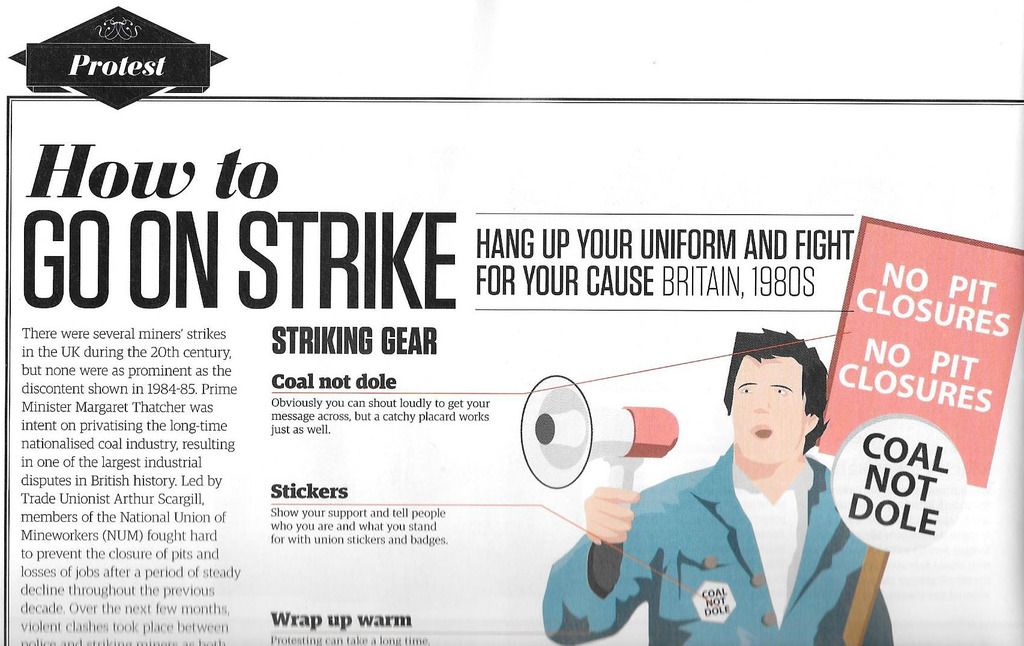
The next spread deals with How to go on strike and gives a pictorial guide to the Miners’ Strike, although there are several facts missing. The very first window is entitled Hold a Ballot, but although we learn the legalities strikers must observe before going out, there’s no mention that the National Union of Mineworkers(NUM) held two national strike ballots in 1982 and one in 1983 it lost all three, and had to resort to holding ballots on a region-by-region basis and concluding that the activist-enforced victories added up to a mandate for a national strike, which was illegal both under UK laws and the NUM’s own constitution, leading people both within and outwith the NUM to conclude that the strike was more about trying to spark a regime-changing revolution than fighting for admittedly bad pay and conditions. Neither do we get the chance to read that there were 989 coalmines employing 502,000 people in 1964, the year Labour’s Harold Wilson started his first stretch as Prime Minister (with the Tories’ Edward Heath holding the post 1970-74) and 219 mines employing 242,000 people in 1979, when James Callaghan, having taken over following Wilson’s resignation in 1976, lost the election to Margaret Thatcher. Nor, unforgiveably, is there any mention of David Wilkie, the taxi driver murdered by two strikers, Reginald Hancock and Russell Shankland, because he was taking a non-striking miner to work. The only mention of violence is:

Acts of violence could alienate some of your supporters. Getting thrown in jail can help gain sympathy to your cause, but you can’t stand on the picket line when under lock and key.

And on the strike’s end, the magazine counsels:

it is important to know when a battle is lost. Cut your losses and you may return another day to win the war.

Some pages on – and significant given Shadow Chancellor John McDonnell’s chucking Mao’s Little Red Book at Chancellor George Osbourne – is a Lonely Planet-style guide to Maoist China which, while not quite a celebration, mentions that Chinese people "die in their millions" under Mao’s leadership, but leaves out the scale: at least 50 million people, many more than Hitler and Stalin combined. A little later comes an article entitled What if Trotsky had come to power?, which again is not a hagiography, but is remarkable given the Trotskyist tendencies of Labour’s new leader, Jeremy Corbyn, and his followers.

Magazines are often compiled over the course of weeks if not months, but the BMA strike was decided on in mid-November, which would have given politically-skewed personnel ample time to partially clear the decks and produce an overtly political "bookazine", printed on glossy paper and with lots of illustrations, that would be especially attractive to young people (David Butt, Group Managing Director of Imagine Publishing, All About History’s parent group, states the company took on many former Ladybird illustrators").

For this reason, I advise you to buy All About History issue 034 for a rare insight an how the wider educational establishment is presenting a skewed narrative to younger people in order to co-opt them as footsoldiers in the war to right what they perceive as being history’s wrongs.

Gerry Dorrian

Recources

Historical coal data: coal production, availability and consumption 1853 to 2014, gov.co.uk - click link to open spreadsheet

McDonnell's great leap forward puts Osborne one step ahead John Grace, The Guardian, 25 November 2015

From the archive, 1 December 1984: Taxi driver killed by striking miners Sarah Boseley, The Guardian, December 2014

Ian Burrell: The publisher of 'bookazines' hopes his reliable, unstuffy medium will appeal to parents everywhere Ian Burrell, The Independent, December 2014

Imagine Publishing homepage

All about History Issue 34

Monday, 11 January 2016

some estates need bulldozed, but they sink because of people

David Cameron’s vow to take the bulldozer to sink estates applies to England, but I thought some lessons from my homeland might prove a cautionary tale for him.

In Glasgow, there was a much-trumpeted slum clearance project in the 1950s. I’m sure it was proposed for the best of reasons, but what it turned into was an exercise in social cleansing, in that when the slums were knocked down – and they did need knocking down – working-class people were moved out of the city centre and relocated at its periphery. Talk about deconstruction at work! Unfortunately, not all went well in the new estates, and for a simple reason: the same people who made the slums worse than they needed to be turned the new estates into sink estates.

The borderline and more-than-borderline psychopaths who keep people divided and tied up in crises are fireproof: at best landlords are scared of confronting them, and at worst they are invaluable to landlords because they prevent effective tenants’ committees to form and stay stable long enough to hold said landlords’ feet to the fire.

This is, as I say, a Glasgow story, but I would be very surprised if it were just a Glasgow story.

The millionaire songwriters of Squeeze, who changed the lyrics of Cradle to the Grave to send a message to the Prime Minister on the welfare State, might have been lucky enough to get out of council housing before drugs took hold, more in some areas than in others. But I lived through it, so please forgive me for my lack of misty-eyed nostalgia. To make things worse, Glasgow Housing Authority (later Glasgow Housing Association) was so fiscally incontinent as to run up almost a billion pounds in debt, meaning it could do nothing to upgrade its stock, and GHA’s leader was forced to admit that nobody who could afford to live elsewhere was living in its stock. Again I’d be surprised if this were purely a Glasgow story, even if the scale of folly is unique.

Many housing estates do need bulldozing, because they were built not out of respect for human families but along the lines of battery farms, confining the maximum number of voters in the minimum space. But beware agenda contamination: will the new houses be smaller so there’s more of them, to disguise the overpopulation crisis arising from open-door immigration? Will the input of EU money be trumpeted in order to influence the result of the referendum and settlements thereafter?

The ball’s in your court, Prime Minister.

Gerry Dorrian

Thursday, 24 December 2015

Call the Midwife and the bleak road to Bethlehem

In Christmas Eve’s Daily Mail, Libby Purves writes a heartwarming piece about the Call the Midwife Christmas Special and how the series as a whole provides an island of emotional comfort in the cynical ocean that modern life has become.

It would be cynical of me, therefore, to point out that Purves, who predicts that BBC’s Call the Midwife’s Christmas Special will outperform ITV’s rival Downton Abbey offering, has been a BBC radio presenter since the 1970s and is using the article to curry favour with her managers.

But there’s a whole further level of cynicism to go to. Call the Midwife seems not just to be an evocation of a fondly-remembered past but also a reflection of how the Establishment works, in that it depicts middle-class professionals doling out largesse to a poverty-stricken and prejudice-ridden populace.

In fairness to the programme makers, that's not a million miles away from how the healthcare Establishment sees itself. A friend’s mother, as a staff-nurse in the 1960s, was reprimanded for “socialising with care assistants”, the latter being traditionally drawn from more working-class backgrounds as the professionals. In the 1980s as a student nurse myself, I had to endure a lecture from a ward-sister on how people from my part of Glasgow’s East End were uneducated, feckless and had too many children. Nowadays it becomes harder and harder for people of working-class backgrounds to become nurses as the entry level qualification is a degree – heaven knows why – and when was the last time you were treated by a senior doctor with an inner-city accent?

And sometimes the programme-makers’ own prejudices show through the slick production, now that the storyline has moved beyond Jennifer Worths original memoirs. For example, in the 2014 Christmas Special, we see a mother-and-baby home for unmarried mothers where the care standards are appalling. The doctor comments, “these places used to be run by charities, then they were taken over by the council”. In fact, the original National Health Service White Paper of 1944 envisaged control of services on the ground by local and borough councils, but with the 1946 National Health Service Act Aneurin Bevan expropriated the councils – and therefore the councillors and the electorates who voted for them – in order to nationalise the whole thing and place it under the control of predominantly unelected officials, ground-level services being entrusted to local health authorities, now trusts and clinical commissioning groups, which were and are almost completely outside of democratic control and oversight. The subtext of the doctor’s comment was, I think, that democracy was not the proper system from which to run services that reach out to “ordinary people”, as I believe we of the non-elite are now called.

I suppose this year’s Call the Midwife Christmas Special will provide an island of warm fuzziness in the bleak ocean of exclusion we all now founder in, and sometimes that’s what the doctor ordered. Programmes like Call the Midwife manipulate our brain chemistry to produce a sense of supported catharsis – a good cry, in other words. But sometimes it’s time to put down the tissues and see the world as it really is. As Mary and Joseph discovered on the bleak road to Bethlehem, the world is cold and unforgiving, and nobody comes to mitigate this. Sometimes the solution can only be that we have to create warmth and forgiveness by ourselves, because when nobody comes then each individual has to ponder whether it is he or she that has to act.

I hope you manage to draw what warmth and forgiveness you can from whatever source you can find this season. As the sun sets on freedom and democracy the road ahead is bleak, and I hope we find each other in the coming year. Resources A magical reminder of a time when those in need really felt cared for: As Call The Midwife is set to top Christmas Day ratings, we can learn something from a bygone era by Libby Purves, Daily Mail 24 December 2015 Call the Midwife Christmas Special 2015 BBC webpage A National Health Service White Paper of 1944 National Health Service Act, 1946

Tuesday, 5 August 2014

Israel and why Westphalia matters

In 1648, the Peace of Westphalia ended the 30 years' war by esconcing Cardinal Richelieu’s principle of raison d’état – justifying Catholic France’s alliances with Protestant powers to prevent absorption into the Holy Roman Empire – as the defining principle of the nation state.

Under raison d’état each state was free to run its legal internal affairs as it wanted, for example responding to pressures for universal suffrage at its own speed.

When Tony Blair was elected in 1997, he trumpeted a post-Westphalian settlement which would see Britain not only buy into the European Union’s supra-national agenda like never before, but participate in wars to spread neo-conservative values to Afghanistan and Iraq in what former US Deputy Defence Secretary Robert Ellsworth called "salvation without representation".

In Israel’s Gaza campaign, we’re seeing a demonstrably democratically-elected government take on Hamas, a group banned in many countries for its links to terrorism. It is in a sense a campaign against the crisis-hit post-Westphalian movement, where

it is the "internal" boundaries that create problems. Security, defence of privilege, identity, recognition and cultural traditions…are now altered, uncertain, liquid. They are no longer reliable.

Egypt’s sponsoring of a ceasefire between Israel and Hamas is also a classic Westphalian move: Egypt is one of the states that have banned Hamas. If Palestinian terrorists (by no means all Palestinians) were to catastrophically weaken Israel, the terrorists’ first move would be to announce themselves part of the soi-disant caliphate proclaimed by Jihadis in Iraq and Syria.

This is also a supra-national power, but far removed from the multilateral transfer of rules with the EU as template dreamt of by Blairites. It is an attempt to rebuild the Ottoman Empire, and as such the next stop would be Egypt, therefrom the rest of Arab Africa.

Israel is certainly fighting for survival, but it is now at the centre of the fight for the nation-state system. All of us who value freedom need to realise that freedom lives or dies with Israel.

Gerry Dorrian
300 words

Resources

Imposing Our 'Values' by Force - Robert F. Ellsworth and Dimitri K. Simes

A Crisis Of The State? The End Of The Post-Westphalian Model - Carlo Bordoni

The EU as a Multilateral Rule Exporter: The Global Transfer of European Rules via International Organizations - Mathieu Rousselin

Friday, 1 August 2014

comparisons between Hamas and Nazis aren't made lightly

During the Second World War, the British visited a lot of attrition on Germany and on Germans for a very good reason: it was them or us.

The Israeli Foreign Minister harked back to this time when he delivered a message to his counterpart here, Stephen Hammond, on the conflict in Gaza:

[Foreign Minister Avigdor] Liberman told Secretary Hammond that Israel expects special understanding on the part of the British. During one of the most difficult but greatest hours of Great Britain, when London was bombed during World War II, we learned from Churchill that even if the price is blood, sweat and tears, a nation that wants to survive must fight for its freedom.

Any comparison between Hamas and the Nazis is neither done lightly nor without justification. In November 2013, the Palestinian university in Jerusalem, Al Quds, made international news when it hosted a Nazi-themed rally; six months earlier – shortly before the murder of Gunner Lee Rigby – the Swastika was spotted flying over the town of Beit Omar.

This is what the Israelis are facing: a war that is basically a continuation of the one we faced from 1939-1945; a war that is not about land or money or power but the very existence of the Jewish people. Those brave Palestinians who realise and reject this know the risks they run: recently jihadis murdered 25 peace activists and blamed it on Israel even as Palestinian rockets, by accident or design, fall upon Palestinians.

As genocide is prosecuted in Syria and Iraq, our prone media prioritise manufactured outrage at recycled pictures and promote the BDS agenda. The original Nazis were more honest in their evil when they verbalised their version of BDS: kauf nicht bei Juden – don’t buy from Jews. As jihadis and their useful idiots shout and fly Palestinian flags over council buildings, please spare a thought about where the Swastika and kauf nicht bei Juden were headed from the start. There's been no change in plan.

Gerry Dorrian
300 words

Wednesday, 5 March 2014

the political super-elite: "universal suffrage gave the wrong people the vote"

Between 1945 and 1956, Austria saw four general elections produce parliaments in which the opposition’s tussles with government were choreographed, for which Austrians coined the term Bereichsopposition. This might translate as opposition arranged within a set area; Marxist social scientist Otto Kirchheimer, writing in 1957, translates it as "opposition of principle," which he defined later as "'the desire for a degree of goal displacement incompatible with the constitutional requirements of a given system".

Kirchheimer’s 1957 paper The Waning of Opposition in Parliamentary Regimes rails at the birth of the cartel arrangement of politics, whereby a group of parties with little to differentiate them dominate parliamentary politics. He notes this was an "extreme procedure" in Austria, but that the same arrangements were emerging in (West) Germany, France and Italy.

These three were the main signatories to the Treaty of Rome the next year. This transformed the European Coal and Steel Community, intended to prevent another war between France and Germany, into the EEC, the proto-EU.

Peter mair - click for obituary

Left-leaning political scientists like Kirchheimer and Peter Mair (right - whose Ruling the Void references the former’s essay) are pessimistic about the outcome of cartel politics. This seems to stem from a middle-class phobia of the revivifying power of the popular vote: a primal suspicion that universal suffrage gave the wrong people the vote. Walter Bagehot’s fear that "ultra-democratic" politics (universal suffrage – "the rich and wise are not to have, by explicit law, more votes than the poor and stupid") will lead to "violent laws" leads straight to Mair’s phobia of populist politics.

Think of this when you hear Conservative, Labour and Lib Dem politicians slate UKIP: you are hearing the self-serving super-elite of the anti-democratic political cartel, perpetually mired in oppositionalism to the mechanisms of government in Brussels, inform you that universal suffrage gave the wrong people the vote.

Gerry Dorrian
300 words

Resources

The Waning of Opposition in Parliamentary Regimes - Otto Kirchheimer, Social Research, Vol. 24, No. 2, Summer 1957. Link takes you to the essay on JSTOR, where permissions may be required. You can click here to try to access the pdf

Political Perfectionism and the 'Anti-System' Party - Michael keren, Party Politics 6, January 2000: a summary of the article giving Kirchheimer's definition of "opposition of principle"

Treaty establishing the European Economic Community (Treaty of Rome)

The English Constitution - Walter Bagehot, second edition, 1873. The quote about giving the vote to the "poor and stupid" is on p127 of the pdf

Friday, 31 January 2014

(neo)feudalism and the EU

The first use of "neofeudalism"seems to have been in 1940, when a doctor complained to the Medical Times about the consequences "if medicine was to be neofeudalized by the state". (Obamacare, anybody?)

Political scientist Guillermo O’Donnell ran with the idea, identifying neofeudalism within "those regions where the local powers…establish power circuits that operate according to rules that are inconsistent with, if not antagonistic to, the law that supposedly regulates the national territory".

European patriots can see the reverse process to O’Donnell’s happening in regard to the EU today – the supranational giant has established power circuits that operate according to rules that are inconsistent with, if not antagonistic to, the systems of laws that supposedly regulate the national territories.

click for the Atlantic Arc webpage
For example, the Atlantic Arc unites fragments of the UK, Ireland, France, Spain and Portugal that have no other link than that the Atlantic laps upon their coasts; and the BBC has admitted taking £3m in grants from the EU, and acts as the EU’s propaganda outlet in the UK.

Like the feudal overlords of old, the EU has enlarged its fief by sleight of hand; it wasn’t announced to the British people until 2001 that "this country quite voluntarily surrendered the once seemingly immortal concept of the sovereignty of parliament and legislative freedom by membership of the European Union". By then all that was needed was a dynastic marriage in the form of a constitution: the Lisbon Treaty was signed by Gordon Brown under the so-called "democratic" mandate of the 2005 election.

So what destroyed feudalism? Here, after the Peasants’ Revolt of 1381, in the words of Marxist writer Mark Starr, "the peasants were never reduced to the old Feudal bondage again, and a time of prosperity for them, known as the Golden Age, followed". Neo-feudalist bureaucrats of the Paris-Berlin axis take note.

Gerry Dorrian
300 words

Resources

Excerpt from a 1940 letter to the Medical Times - the first recorded use of "neofeudalism"?

On the State, Democratisation and some Conceptual Problems (A Latin American View with Glances at Some Post-Communist Countries) - Guillermo O'Donnell - go to p10 of the .pdf for a description of what he calls "neofeudalized"

Atlantic Arc homepage

BBC admits receiving millions in grants from EU and councils - Christopher Hope, Daily Telegraph, Feb 2012

Britain and Europe: The Culture of Deceit - Christopher Booker, October 2001; the passage quoted is at the top of the article

Mark Starr: A Worker Looks At History - Chapter 8 The Fall of Feudalism

Did Labour win the 2005 general election? - 300 words

Monday, 27 January 2014

neo-fascism and neo-corporatism: The Emergence of the Cartel Party

Régime censitaire is an interesting phrase: cens was a fee paid to a feudal lord which sometimes accorded voting rights. Thus the régime censitaire refers, in Peter Mair’s and Richard Katz’ seminal 1995 article Changing Models of Party Organization and Party Democracy: The Emergence of the Cartel Party, to the state of democracy in the late 19th century, where some degree of property ownership was necessary in order to vote.

The "cartel party" refers to a situation where major parties compete for an electorate’s votes with none offering anything qualitatively different from the other, therefore they gain more from cooperating with each other than competing, to democracy’s cost. (Hobbling the free press, anyone?)

Parties evolve from "caucus" entities representing the minority entitled to vote to “mass parties” upon universal suffrage, then "catch-all" parties offering all things to all people, little different from each other. Here the titular cartel starts to form.

Scarily, Mair and Katz note that other bodies such as trade unions and employers’ associations "[develop] relationships with the state that are not unlike those developed by the parties themselves" – I would add developers and the diversity industry. They call this "neocorporatism". I have to wonder if they were referring to a quote by Mussolini, "Fascism should more properly be called corporatism because it is the merger of state and corporate power". Is neo-fascism the corollary of neo-corporatism?

There is hope: new parties can challenge the cosy huddle, but must resist the trap the Liberal Democrats (identified by the authors) have fallen into of joining "the establishment they once decried".

Mass parties on either side of the pond produced Churchill, Attlee and Thatcher, and FDR, JFK and the Bushes before political cartels reincarnated the régime censitaire by restricting power within the circle of those who possess it already.

My money’s on UKIP and the Tea Party to shake things up. How about yours?

Gerry Dorrian
300 words

Resources

Changing Models of Party Organization and Party Democracy: The Emergence of the Cartel Party - Richard S. Katz and Peter Mair, originally from Party Politics

(Leveson deal: MPs debate press legislation: as it happens - Rowena Mason, Daily Telegraph, 18 March 2013

"Mussolini on the Corporate state - Political Research Associates

Click for reviews of Ruling the Void: The Hollowing of Western Democracy, in which Mair's ideas on the political cartel arising from the article reviewed were posthumously developed from his notes

click for a review of The Triumph of the Political Class, in which Peter Oborne continues on Mair's ideas in Ruling the Void

Monday, 13 January 2014

CJ Sansom's "Dominion": a low punch at UKIP

click for reviews on amazon.co.uk

It’s now widely accepted that Winston Churchill had a "wobble" in his now-famous three days in May 1940 when he was occupied by the feasibility of negotiating a peace with Hitler’s Germany after the "Narvik Debate" on the disastrous Norwegian campaign brought down Neville Chamberlain’s Conservative government and Churchill came to lead a tripartite National Government.

In CJ Sansom’s alternative history novel set in 1952, Dominion, Churchill was rejected in favour of Lord Halifax as leader of the Tories. Following the Dunkirk evacuation, a crisis in Parliament led to those peace negotiations with the Nazis, and Great Britain became effectively a German vassal state under the leadership of Lord Beaverbrook.

I don’t agree with Sansom’s intimations in the novel that patriotism is by nature evil. Nevertheless, taking something you normally wouldn’t pick up and turning it into something you can’t put down is the mark of a great writer.

What worried me is that, after the end of the novel, Sansom presents an essay on his views on Nazism, nationalism and patriotism in general (which, in conjunction with Palestine – ie Israel – he cites as the two great blights of the real postwar world). At the end of the essay, in which Nazism and fascism are extensively mentioned, he opines that UKIP is another manifestation of the "blight" of patriotism.

He offers no opinion on the EU which, although not a national or nationalist entity, many would point to as non-violent fascism. By the time he comes to UKIP, after pages spent railing against fascism and associating patriotism therewith, the footnotes have dried up, but the intention seems to give the reader the idea s/he is reading an academic essay condemning UKIP.

Should we be asking Macmillan whether, should it reprint Dominion before the 2015 General Election, it will reprint Sansom's tendentious essay?

Gerry Dorrian
300 words

Resources

Three Days in May: When Winston Churchill wobbled - Jasper Rees, Telegraph

Conduct of the War Hansard minutes of House of Commons debate of May 8 1940, also called the Norwegian Debate/Narvik Debate

Click to read reviews of Dominion at Amazon

Pan Macmillan (publishers of Dominion) contact page

Wednesday, 8 January 2014

voter ID: the story behind the Electoral Commission's announcement

If the Electoral Commission wants voters to produce IDs at polling stations Parliament could effect this by amending the Representation of the People Act: it's been amended 42 times in its lifetime.

The furore revolves around the 2000 Act’s amendments of the 1985 Act.

Sections 5-9 of the 1985 bill present various safeguards ensuring that absent voters using proxies or postal votes assure the Registration Officers of their identities.

Section 12, para 2 of the Representation of the People Act 2000 informs us that "Sections 5 to 9 of the Representation of the People Act 1985...shall cease to have effect" apart from in Northern Ireland. Replacing them is Section 4, relating to people in mental hospitals who are not detained offenders or on remand.

In other words, the 2000 act allows party activists to satisfy themselves of the identities of absent voters.

Nick Ross’ thesis, expanded in his book Crime, is that crime isn’t facilitated by bad people so much as that which is pilfered being readily available.

In the recent past what’s been pilfered appears to have been votes, to such an extent that even the International Committee of the Fourth International got worked up about it in 2004. The following year, in terms of raw votes, Tony Blair’s New Labour won by 1,500,000, in a General Election in which 6,000,000 postal votes were returned.

But from which "high risk areas" (the Electoral Commission’s words)? These are the ones they identify:

Birmingham, Blackburn with Darwen, Bradford, Burnley, Calderdale, Coventry, Derby, Hyndburn, Kirklees, Oldham, Pendle, Peterborough, Slough, Tower Hamlets, Walsall, and Woking.

I can identify 7 areas above where the population makeup is skewed away from the average mix in the UK. So why does the Government want to foist ID cards through the back door on all of us?

Gerry Dorrian
300 words

Resources

ID needed at polling stations, recommends independent watchdog - Electoral Commission: see Editor's Note para 2 for the "high risk areas"

Representation of the People Act 1985 - see sections 5-9 as mentioned

Representation of the People Act 2000 - see Section 12, para 2 and Section 4 as mentioned

Nick Ross's Crime - 300 words

- Britain: opposition to Iraq war led to Labour vote-rigging in 2004 elections World Socialist Web Site, published by the International Committee of the Fourth International

Monday, 16 December 2013

Popper's theses on gov't (7) - liberalism is evolutionary, not revolutionary

Principles of Liberalism may be described (at least today) as principles of assessing, and if necessary of modifying or changing, existing institutions, rather than of replacing existing institutions. One can express this also by saying that Liberalism is an evolutionary rather than a revolutionary creed (unless it is confronted by a tyrannical regime).

In Karl Popper’s penultimate Liberal Thesis, he delineates tradition’s role: the means for an institution to evolve as situations change, or – perhaps more sinisterly – as the Establishment’s view of the institution’s purpose changes.

Sir Richard Mayne - click to learn more
One of several institutions I could mention in illustration is the police. While Sir Richard Mayne (right) defined police work in 1829 as "the prevention of crime [and] detection and punishment of offenders if crime is committed", as mass immigration changes our national makeup police become increasingly the enforcers of last resort when British culture opposes that of the Establishment’s favoured ethnicities. Thus, we see the English flag described as "racist" and a Christian preacher arrested for saying what has been in the Bible for millenia.

(I’m not criticising rank-and-file police, merely illustrating how Establishment opinion drift causes institution mission drift.)

read more about Democrat quote
In qualifying liberalism’s evolutionary nature with the caveat that it can become revolutionary when confronted with tyranny, Popper recognises the contributions liberal philosophy and politics made to the American, French and various humanitarian revolutions. It’s necessary to remember, though, Public Opinion and Liberal Principles appeared in 1956, before liberal leaders worldwide prostituted the movement’s vitality to the left, causing Ronald Reagan (left) to say "I never left the Democrats, the Democrats left me".

But Popper’s unquestioning acceptance that liberalism’s evolution will be in a socially positive direction contradicts a point made elsewhere in Conjectures and Refutations wherein he takes Hegelians and Marxists to task for assuming the same, through mistaking Kant’s triadic layout of his categories for a statement that syntheses will always be preferable to the conflicts they resolve. That, as institutional mission drift shows, depends on the Establishmentarian agenda regarding the conflicts.

I think Popper would reply that in the open society we can’t afford to make any thinker carry the cross of infallibility.

Gerry Dorrian
300 words

This series:

Popper's theses on gov't (1): state a necessary evil

Popper's theses on gov't (2): democratic government can be got rid of without bloodshed

Popper's theses on gov't (3): democracy confers no benefit on citizens

Popper's theses on gov't (4): we're not democrats because the majority is always right

Popper's theses on gov't (5): institutions are insufficient without traditions

Popper's theses on gov't (6): Utopia is an impossibility

Popper's theses on gov't (7) - liberalism is evolutionary, not revolutionary

Resources

History of Policing - Metropolitan Police

Motorist told flag could be racist - Charley Morgan, This is Wiltshire, May 2008

Christian preacher arrested for saying homosexuality is a sin - Heidi Blake, Daily Telegraph, may 2010

"Why Reagan Was 'The Great Communicator' - Craig von Buseck, cbn.com

Wednesday, 11 December 2013

Popper's theses on gov't (6) - Utopia is an impossibility

A Liberal Utopia – that is, a state rationally designed on a traditionless tabula rasa – is an impossibility.

As one of the last Enlightenment philosophers – indeed the one whose legacy did most to shut the Enlightenment down – Karl Marx, like many others, set himself the task of planning out a brave new world where people would live happily and without oppression.

This didn’t happen in a vacuum. In 1772 Denis Diderot had published his Supplément au voyage de Bougainville, a year after the eponymous captain had published the accounts of his circumnavigation of the world which including a visit to Tahiti, which he initially described as an egalitarian paridise. He then revisited this opinion, saying he had overlooked the "cruel inequalities" between different ranks on the island.

But before they got to that bit, swathes of European philosophers had acquired what we might call, to mangle a Star Trek phrase, Tahiti Syndrome by Proxy. Marx was one of many to plan out a Utopian future for Europe, not bothering to ask himself when he referred to the work in Capital why Thomas More had set his paradise on a fictional island.

Utopia never materialised in the Paris Commune, and in its first 20th century manifestation it was taken to Russia by Lenin, who was sent there by the Germans as a unique weapon of mass destruction that would take his country out of the war. Cutting all ties of tradition meant, as Popper said in his 5th thesis, that Russia became the opposite of what the Communists had intended: more repressive and more colonial than it had under the Tsars.

History shows a long, painful journey to attain what rights the Russians had in 1916. We had no less a long, painful journey before the Utopian Lisbon Treaty was signed in 2007, sweeping aside centuries of tradition and common law. We need to reconnect our country to its tradition before Utopia takes the path it has always done.

Gerry Dorrian
300 words

This series:

Popper's theses on gov't (1): state a necessary evil

Popper's theses on gov't (2): democratic government can be got rid of without bloodshed

Popper's theses on gov't (3): democracy confers no benefit on citizens

Popper's theses on gov't (4): we're not democrats because the majority is always right

Popper's theses on gov't (5): institutions are insufficient without traditions

Popper's theses on gov't (6): Utopia is an impossibility

Popper's theses on gov't (7) - liberalism is evolutionary, not revolutionary

Resources

Supplément au voyage de Bougainville (French) - Denis Diderot - project Gutenberg

Voyage Autour du Monde (French) - Louis Antoine de Bougainville - franceinfo.us - the passage about the cruel inequalities (la disproportion cruelle) is on p99 of the pdf

Capital - Karl Marx - Internet Archive - use the search function on your browser to locate quotes about Utopia

Utopia - Thomas More - history_wodls.org/Planet PDF

The Sealed Train full text of Michael Pearson's book on Lenin's journey to Russia to establish a communist state

Tuesday, 10 December 2013

is the Kenya mutiny symptomatic of wider unrest?

The sit-down strike by soldiers of the 1st Battalion (Yorkshire Regiment) was a very British mutiny. I suppose in a sense Corporal Anthony Brown was lucky to be merely thrown out of the Army: after the 1917 Étaples Mutiny, Cpl Jesse Robart Short was executed for calling an officer a “bugger”.

The present action, taken during the Askari Thunder exercise in Kenya, also stemmed from the actions of people in charge: two commanders – who haven’t had their names plastered all over the press like the enlisted men – got drunk the night before a forced march and were found after the exercise sleeping off their hangover.

Incidents like this never spontaneously erupt; the discontent is usually slow-burning, with a possibly small incident turning into a flashpoint, the straw that broke the camel’s back.

It’s also impossible to ignore what’s going on around at the same time. We have the trial of one of Gunner Lee Rigby’s killers, who has been heaping praise on the nursing and medical care he has received, treatment he ensured Gunner Lee would not live to benefit from.

And of course there’s Marine A (Sgt Alexander Blackman), who was sent to Afghanistan to engage with terrorists in irregular warfare, and is facing 10 years in prison for doing precisely that.

There is an inequality inherent in any functional system, without which systems tend to collapse – but that itself can lead to system collapse when the inequality gap is unbridgeable.

This happened literally in the Étaples mutiny, when the officers appropriated billets in the posh resort across the bridge and left troops to fester on the wrong side of the river. If what happened in Kenya is symptomatic of a wider dislocation between officers and enlisted soldiers, perhaps the veteran Fusiliers’ march on London was but the politest of warning shots.

Gerry Dorrian
300 words

Resources

Afghanistan veterans jailed for parade ground sit-in protest over "muppet" officers - The Huddersfield Daily Examiner

Court-martial of Cpl Jesse Robart Short - National Archives

Lee Rigby murder trial: 'I’m a soldier just like Drummer Rigby... I killed him because this is war’ - Tom Whitehead, Daily Telegraph, 9 December 2013

Sgt Alexander Blackman: Marine backed by 60,000 people over killing of Taliban insurgent - Daily Mirror, 8 December 2013

Breaking: 100,000 people (the threshold that should trigger Parliamentary time for a topic) support Sgt Alexander Blackman - Daily Mail, 11 December 2013

Click to sign the HM Government e-petition to free Sgt Alexander Blackman (Marine A) - at time of writing 37,691 signatures

Veteran Fusiliers to march on London - ITV news, October 2012