Showing posts with label education. Show all posts

Monday, 12 June 2017

Heidegger's arithmetic

Jeremy Corbyn, the Labour Party leader, has been feted as winning a great victory – with The New Statesman, for example, publishing a piece called Jeremy Corbyn won a great victory. His party won 262 seats and Theresa May’s Conservatives won 318.

Has the Left lost all grasp of arithmetic? Unfortunately not. What we are seeing is a political arithmetic from a very sinister time in the first half of the twentieth century in Germany: Heidegger’s arithmetic, from his 1927 work Being and Time.

Martin Heidegger was, famously, “Hitler’s philosopher”. He rebelled against the phenomenology of his mentor, Edmund Husserl, which allowed each person an equal right in collectively constructing the world; instead Heidegger divided humanity into two: the “authentic” and the “inauthentic”.

The authentic are the people who, in Heidegger’s view, matter: the elite, even the Master Race. Their thoughts count for much more than the inauthentic, the rest of humanity in an amorphous herd whom Heidegger calls “the they”, whom Heidegger accuses of the tendency to establish a dictatorship of “inconspicuousness and unascertainability”. It’s not difficult to see how those eager to apply a veneer of intellectual respectability to that franchise of street-fighting gangs called the Nazis saw something they could use in Heidegger’s philosophy and adopted it as their ideology. The classification of the inauthentic as the Other, the they, powered the Holocaust.

In 1940-41 Jean-Paul Sartre read Being and Time while a prisoner of war, and would use it as an inspiration for his existential work Being and Nothingness, in which he retains Heidegger’s classification of “the they”, defining it again as the Other, an amorphous mass that “disintegrates” when one tries to understand it.

Sartre’s importance is not so much in what he wrote, but in that his work provided a bridge for Heidegger’s influence to travel from the Right to the Left – Jacques Derrida, for example, was dismissive of Sartre as “merely another metaphysician”, but his breakthrough and most influential work, On Grammatology, is full of references to Heidegger.

There was a golden age of socialism in Britain. It started in 1948 when Clement Attlee’s government instituted full and equal suffrage with the Representation of the People Act 1948 and founded its corollary, the NHS. And it was ended when the OPEC oil crisis of the mid-1970s swallowed up the money that makes any golden age possible. In the wake of this, the socialists who followed used Heidegger-ridden logic to justify their rejection of democracy as a means to pursue the socialist agenda, a justification that was, in their eyes, intensified when the OPEC-fuelled crisis reached full penetration and swept Margaret Thatcher to power in 1979 after the “winter of discontent”.

That’s when Heidegger’s arithmetic became as fully accepted by the hard Left as it had been by the Nazis – not that surprising when you consider politics is a circle, so that as left and right descend below the horizon of democracy they continue to become more distant from the open society, but get closer to each other: see the diagram on the book cover below. So we had Militant running Liverpool City Council in the 1980s, justifying the misery it caused to its own working-class employees by the glories of the Revolution to come: Heidegger’s arithmetic in action.

Heidegger’s arithmetic is also apparent in the attitude of former Home Secretary Diane Abbott sending her son to private school while opposing increasing grammar-school places for working-class children: the offspring of “the they”, the inauthentic, must be denied any opportunity to be able to compete with the children of the elite, the authentic, so as to deny them an intellectual foundation from which they might set out to frustrate the goals of the elite. These goals have never, at any time, had anything to do with enabling the many - the working-class, "the they", to better their lot.

And Heidegger’s arithmetic shines through in Jeremy Corbyn’s composure as a general who has won a great victory: his hard-Left MPs are the elite, and any MPs opposing them, even if they are numerically superior, are inauthentic and therefore their numbers count as nothing.

Nothing is so toxic to Heidegger’s arithmetic as full and equal suffrage democracy, which is why Corbyn has radicalised a horde of young idealists to oppose democracy by calling for restricting the franchise to those under 60. If they succeed in this it is the beginning of the end for democracy: the next step will be epistocracy, where people have to pass exams before they are deemed able to vote by a state who would only pass those who would vote according to its wishes. At present, the only qualification you need to vote is the capacity to suffer because of the deeds or misdeeds of your government, and this must remain so if you wish to be safe from your government.

If this radicalised cadre manages to decentre full and equal suffrage as a means of deciding who rules, we can only make our opposition to our rulers known by unrest, which runs the risk of sliding into civil war. And that’s why Heidegger’s arithmetic needs to be put into history’s waste disposal unit.

Read more about Heidegger, the risks to democracy, and Brexit:

Buy Brexit and Democracy from amazon.co.uk (or your local Amazon store)!

Buy Brexit and Democracy from Smashwords!

Saturday, 10 June 2017

Brexit and Democracy is now on Smashwords

Brexit and Democracy: Reclaiming full and equal suffrage from the political cartel is now on Smashwords. A detailed survey of Brexit and the historical, philosophical and political issues surrounding it, this is your unmissable Brexit companion!

  • Why did it take the Scottish National Party to start an "avalanche of philosophy" in Britain that finally saw the long-promised EU membership referendum materialise?
  • What was the 2012 incident that enabled UKIP to put a crack in the political cartel?
  • Why was nothing done when Otto Kirchheimer started noticing cartelisation in European political parties in the mid-1950s?
  • Did the Marshall Plan unwittingly lay the groundwork for the eventual formation of the European Union?
  • What is the relationship between the German and Italian unification processes and the EU?
  • Did nation states start to evolve from the 1648 Peace of Westphalia, or from the 1555 Peace of Augsberg?

Buy Brexit and Democracy from Smashwords!

Buy Brexit and Democracy from amazon.co.uk (or your local Amazon store)!

Saturday, 25 June 2016

Article 50 may be legal, but was Gordon Brown's premiership valid?

Tony Blair may not be telling the whole truth about the reasons for his unhappiness with the British EU referendum result.

When he says Brexiteers "dismissed" the Remain campaign as scaremongering, he seems - seems to be buying into the absolutely toxic stream of thinking that questions the intelligence of people who voted for Brexit. For more of this see today's Times, which beside the usual graphs of what the regional votes were, gives the average percentage of people in that area with 5 or more GCSEs at A-c. One woman interviewed this morning complained that she was "highly educated" and didn't understand the case for Leaving. Are the metropolitan intelligentsia preparing to take us down a slippery slope, similar to one that caused a lot of trouble in the 20th century?

I believe Blair is nervous because of a little-mentioned change to electoral law during his first term. The Representation of the People Act 2000 effectively legalised postal voting on demand by abolishing safeguards built into the Representation of the People Act 1985 (and earlier versions) which stipulated that anybody who wished to vote by post had to give a reason for doing so to the Registration Officer. A House of Commons Library investigation into electoral fraud dates the rise of such fraud to industrial levels to that change.

Jump to the 2005 General Election, and as you can see in the tables below, the number of postal votes cast were a massive 514% of Labour's majority over the Conservative Party, who were the runner up, ie they formed the main Opposition Party. This is in terms of raw numbers and does not take into account our first-past-the-post system, of course, but look at what the raw numbers are: there were 5,500,000 postal votes, and Labour's majority over the Tories was a mere 770,000. (click to enlarge)

Here's what Judge Richard Mawrey QC had to say about electoral fraud in his famous "banana republic" judgement, delivered two months before the 2005 General Election:

Anybody who has just sat through the case I have just tried and listened to the evidence of electoral fraud that would disgrace a banana republic would find this statement surprising. To assert that ‘the systems already in place to deal with the allegations of electoral fraud are clearly working’ indicates a state not simply of complacency but of denial.

The systems to deal with fraud are not working well. They are not working badly. The fact is that there are no systems to deal realistically with fraud and there never have been. Until there are, fraud will continue unabated.

This matters because, after Tony Blair retired, Gordon Brown signed us up to the Lisbon Treaty.

Article 50 of this treaty specifies the procedure to be followed if a country is to secede from the EU. There has been some debate over whether Article 50 is the sole legal way of achieving Brexit. But there may well be another factor to consider here: was Tony Blair's 2005 election win democratically valid? In other words when Gordon Brown signed us up to the Lisbon TReaty, including its Article 50, did he have a legal mandate to represent the people of Great Britain?

Mr Blair - and Mr Brown - have some very interesting times ahead.

Gerry Dorrian

Resources

Representation of the People Act 2000

House of Commons Library: Postal Voting and Electoral Fraud 2001-2009 (Isobel White, 2012)

House of Commons Library: Election Statistics 1918-2007

House of commons Library Election Statistics 1918-2012

Postal voting an invitation to fraud, says judge Nick Brittien, The Telegraph, April 2005)

Judge Mawrey's "banana republic" remarks on postal voting fraud in full

Tuesday, 12 January 2016

Indoctrination? All About History publishes guide to striking

indoctrination? you decide!

A word can give away so much, and this time the word was “abhorrent”. The word was used by the magazine All about History, saying in a spread entitled Protest across history that the "Red Wedge" of socialist musicians toured the UK in 1987 because of "the abhorrent possibility of a third consecutive Conservative government", in an issue of the magazine timed to come out when many doctors are striking and hard-left unions are pledging to come out in support.

It’s the only point in the feature where an emotive adjective is used to describe the object of protests. Here’s a quick summary of just some of the movements or incidents from the feature that appear not to warrant being described as abhorrent or indeed anything else judgemental:

  • The Imperialist government of India which brought Mahatma Gandhi into conflict with it ( resulting in the Salt March, 12 March 1930)
  • Rosa Parkes being ordered to vacate her seat for a white person in Montgomery, Alabama (Montgomery Bus Boycott, 1 December 1955-20 December 1956)
  • Racists from the US who spawned the Black Power movement (Black Power salute, 1968 Olympics)
  • Homophobes from New York City Council who closed the Stonewall Inn (Stonewall Inn riots, 28 June 1969)
  • Apartheid in South Africa (Soweto School Uprising, 16 June 1976)
  • The Philippines’ murderous Marcos regime (People Power Revolution, 1983-86)
  • Suppression of democracy and democrats in China (Tiananmen Square Protests (15 April-4 June 1989)
  • Tony Blair’s invasion of Iraq in the face of a million-strong protest (Iraq War potests, 15 February 2003)
  • The police shooting of Michael Brown in Ferguson, Missouri (Ferguson Riots, 9 August 2014)

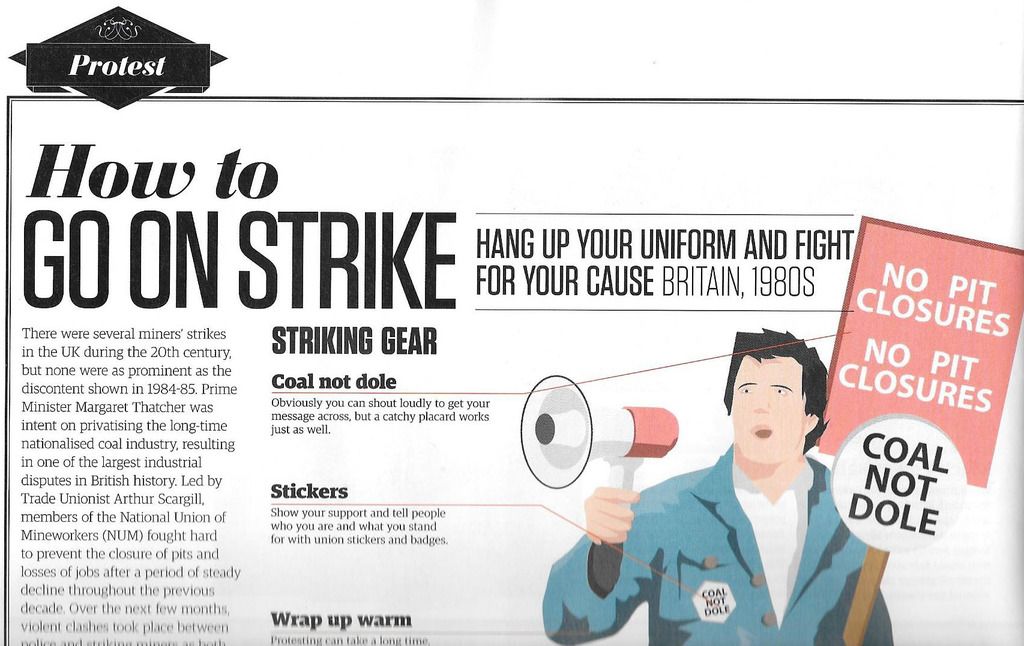
The next spread deals with How to go on strike and gives a pictorial guide to the Miners’ Strike, although there are several facts missing. The very first window is entitled Hold a Ballot, but although we learn the legalities strikers must observe before going out, there’s no mention that the National Union of Mineworkers(NUM) held two national strike ballots in 1982 and one in 1983 it lost all three, and had to resort to holding ballots on a region-by-region basis and concluding that the activist-enforced victories added up to a mandate for a national strike, which was illegal both under UK laws and the NUM’s own constitution, leading people both within and outwith the NUM to conclude that the strike was more about trying to spark a regime-changing revolution than fighting for admittedly bad pay and conditions. Neither do we get the chance to read that there were 989 coalmines employing 502,000 people in 1964, the year Labour’s Harold Wilson started his first stretch as Prime Minister (with the Tories’ Edward Heath holding the post 1970-74) and 219 mines employing 242,000 people in 1979, when James Callaghan, having taken over following Wilson’s resignation in 1976, lost the election to Margaret Thatcher. Nor, unforgiveably, is there any mention of David Wilkie, the taxi driver murdered by two strikers, Reginald Hancock and Russell Shankland, because he was taking a non-striking miner to work. The only mention of violence is:

Acts of violence could alienate some of your supporters. Getting thrown in jail can help gain sympathy to your cause, but you can’t stand on the picket line when under lock and key.

And on the strike’s end, the magazine counsels:

it is important to know when a battle is lost. Cut your losses and you may return another day to win the war.

Some pages on – and significant given Shadow Chancellor John McDonnell’s chucking Mao’s Little Red Book at Chancellor George Osbourne – is a Lonely Planet-style guide to Maoist China which, while not quite a celebration, mentions that Chinese people "die in their millions" under Mao’s leadership, but leaves out the scale: at least 50 million people, many more than Hitler and Stalin combined. A little later comes an article entitled What if Trotsky had come to power?, which again is not a hagiography, but is remarkable given the Trotskyist tendencies of Labour’s new leader, Jeremy Corbyn, and his followers.

Magazines are often compiled over the course of weeks if not months, but the BMA strike was decided on in mid-November, which would have given politically-skewed personnel ample time to partially clear the decks and produce an overtly political "bookazine", printed on glossy paper and with lots of illustrations, that would be especially attractive to young people (David Butt, Group Managing Director of Imagine Publishing, All About History’s parent group, states the company took on many former Ladybird illustrators").

For this reason, I advise you to buy All About History issue 034 for a rare insight an how the wider educational establishment is presenting a skewed narrative to younger people in order to co-opt them as footsoldiers in the war to right what they perceive as being history’s wrongs.

Gerry Dorrian

Recources

Historical coal data: coal production, availability and consumption 1853 to 2014, gov.co.uk - click link to open spreadsheet

McDonnell's great leap forward puts Osborne one step ahead John Grace, The Guardian, 25 November 2015

From the archive, 1 December 1984: Taxi driver killed by striking miners Sarah Boseley, The Guardian, December 2014

Ian Burrell: The publisher of 'bookazines' hopes his reliable, unstuffy medium will appeal to parents everywhere Ian Burrell, The Independent, December 2014

Imagine Publishing homepage

All about History Issue 34

Monday, 2 December 2013

Popper's theses on gov't (5): institutions are insufficient without traditions

Institutions alone are never sufficient if not tempered by traditions. Institutions are always ambivalent in the sense that, in the absence of a strong tradition, they also may serve the opposite purpose to the one intended…To sum up: Traditions are needed to form a kind of link between institutions and the intentions and valuations of individual men [sic].

Popper’s fifth liberal thesis seems a comment upon the national and international institutions set up in the wave of collectivism that followed the Second World War.

I’d like to look at Great Britain’s welfare state, set up to combat the "five giants" identified by Sir William Beveridge in his report of 1942: Want, Disease, Ignorance, Squalor and Idleness.

The welfare state had no traditions in British society and therefore became a political football at elections times, and at other times it housed a massive unelected Establishment intent upon walking a socialist state into our systems, no matter the political hue of the day’s government. The result: Beveridge’s five giants are bigger than ever:

Want:
Food banks are proliferating, as are payday loan companies.
Disease:
The National Health Service is in a perennial state of collapse and, at the last count, 13,000 people have died unnecessarily in just 13 trusts.
Ignorance:
The Teaching Times reports that 17% of school leavers are functionally illiterate; this despite unprecedented funds being pumped into education since 1997.
Squalor:
It seems children are found living in squalid conditions every week, with social services aware of their condition. There's countless articles on this - check it out.
Idleness:
Idleness has long been a political synonym for unemployment. School-leavers struggle to find jobs because older immigrants with more mature social skills take bottom-rung positions that school-leavers traditionally occupied. Further strain is put on the welfare system by immigrants who come here specifically to claim benefits without working.

It’s no surprise that Chancellor of the Exchequer George Osborne has announced that the welfare state needs "permanent cuts" if its cost is to be sustainable. Had William Beveridge been less dazzled by the hope of collectivism, he might have seen that the War to End all Wars was never going to come, and cut his cloth – and ours – accordingly.

Gerry Dorrian
300 words

This series:

Popper's theses on gov't (1): state a necessary evil

Popper's theses on gov't (2): democratic government can be got rid of without bloodshed

Popper's theses on gov't (3): democracy confers no benefit on citizens

Popper's theses on gov't (4): we're not democrats because the majority is always right

Popper's theses on gov't (5): institutions are insufficient without traditions

Popper's theses on gov't (6): Utopia is an impossibility

Popper's theses on gov't (7) - liberalism is evolutionary, not revolutionary

Resources

Social Insurance and Allied Services Report by Sir William Beveridge (The Beveridge Report

Numbers relying on food banks triple in a year - bbc.co.uk

13,000 died needlessly at 14 worst NHS trusts - Laura Donnelly and Patrick Sawer, July 2013, The Telegraph

17% of school leavers "functionally illiterate" - Teaching Times

Autumn Statement 2013: Britain can no longer afford welfare state, warns Osborne - James Kirkup, December 2013

Sunday, 17 November 2013

The Book of Eli

Helen Keller: find out more

Some years ago I attended a lecture by metaphysician Frank O’ Farrell focussing on Helen Keller (right) who, struck blind and deaf in infancy, had only limited ability to communicate her wishes and feelings to those around her.

Helen’s teacher, Anne Sullivan, had a fruitless time trying to teach her to communicate by signs stroked into the palms of the hand – until one day Helen finally understood a particular sign referred to water. Frank’s point was that Helen’s understanding that a particular sign stood for water, despite sharing no similarities whatsoever with water, enfranchised her culturally.

The most widespread example of our ability to create and store symbols – identified by Ofer bar-Yosef of Harvard University as the one element of the Upper Paleolithic revolution that enabled culture to develop – is writing. The three letters "cat" instantly remind us of the feel, sound and haughty behaviour of the beast, although nothing about the written symbols or their pronunciation resembles any of these.

click to read reviews on Amazon
In The Book of Eli, the Denzel Washington post-apocalyptic fable recently shown on Channel 5, writing is almost totally absent. That’s the point, in more ways than one grasps until the denouement delivers a dizzying change of perspective.

Books have been burnt in the aftermath of a war that destroyed technology through electromagnetic pulses. Order has collapsed – and that’s undoubtedly related to the sun setting on literacy; most people can’t read.

Literacy’s long sunset has started in our real-life culture. Pictures still speak a thousand words, but less and less of them are transmitted through printed pages that cannot be electronically altered, eg as this page can be edited. As literacy declines, gullability rises: witness the cachet of "climate" scientists and related charlatans.

That sunset is not yet a done deed. Go buy a book, read it and give it to a friend.

Gerry Dorrian
300 words

Resources

About Helen Keller - Helen Keller International

The Upper Paleoloithic Revolution - Ofer bar-Yosef, 2002: " the storage of symbols...leads to the emergence of modernity", p16 of the .pdf

Read reviews for The Book of Eli at amazon

Friday, 8 November 2013

all that glitters: the hidden secrets of money?

I once volunteered at the Bath Street Citizens’ Advice Bureau in Glasgow. In 1998, a senior member of staff there said at a public meeting that he could lay his hands on proof that the financial system was configured to produce debt. Shortly afterwards the branch was informed we owed a staggering unpaid debt that nobody had heard of. Before twelve months had passed since that meeting, the branch – the busiest in Scotland – had been closed down. We never had a chance to hear the lowdown on the financial system.

go to Hidden Secrets of Money website
So I’ve no idea whether the answer would have been similar to that of Mike Maloney (right), who has posted a series of four videos on Youtube entitled Hidden Secrets of Money. The last episode, The Biggest Scam in the History of Mankind, has gone viral.

There’s no doubt that Mike is selling something: he runs a company that trades in silver and gold. And if the videos stir up anxiety and even panic about the imminent collapse of global currency systems, that would be to his benefit.

However, I’m left rather disturbed by the videos; they have the ring (no pun intended) of truth. It’s been suggested that Gordon Brown sold Britain’s gold to shore up international banking systems as the financial tsunami that still rages approached, but - as Maloney suggests - could countries holding British pounds have actually been demanding the repatriation of their gold? And I’m left wondering (I emphasize this is me and is not said at any point by Maloney) if the coming influx of immigrants from Eastern Europe has been planned in order to soak up the enormous amount of money being printed by the treasury so prices don't start rising precipitously?

I agree wholeheartedly with Maloney that our greatest investment is education. I recommend you watch these videos, do your research, and make your mind up.

Gerry Dorrian
300 words

Resources

Hidden Secrets of Money - YouTube. Episode 1 - each episode links to the next

The Biggest Scam in the History of Mankind - Hidden Secrets of Money on Youtube

GoldSilver.com

Hidden Secrets of Money website

Revealed: why Gordon Brown sold Britain's gold at a knock-down price - Thomas Pascoe, Telegraph blogs, July 2012

Money Week: The End of Britain - 300 words

Tuesday, 15 October 2013

"I am Malala"

click for reviews of 'I am Malala'

The book’s full title says it all – I am Malala: The Girl Who Stood up for Education and was Shot by the Taliban.

Malala describes a childhood in Mingora in the Swat valley – once known as Pakistan’s Switzerland for its ski resorts – that was idyllic despite its poverty. The human story of her upbringing is a universal one – she comments that although her family were poor, her mother’s door was always open; I remember my mother saying the same thing about her own upbringing. The story of mothers selling their traditional gold wedding bangles reminded me of my grandfather and his peers selling their WWI medals to feed their families.

Then the Taliban came, dispensing jihad through its main delivery system, sharia law, itself dispensed through the barrel of a gun. She describes the suffocating nature of the burka, a garment which is alien to Pashtun culture.

Her shooting and subsequent hospitalisations in Islamabad and Birmingham are well-known and, at 16, her determination to see that girls have the right to education worldwide shows she has more fire in the belly than generations of coddled British feminists. Their silence in the face of Muslim girls being subjected to FGM and being removed from education, in Britain, condemns them. Malala, nowever, is a living sign that jihad and sharia by no means constitute the natural habitat of Muslims, and I wish her well.

As soon as I finished the book my wife snatched it and my daughters have dibs: it’s a book that demands to be read, and I predict that demand will be satisfied. How about putting it on the National Curriculum?

Gerry Dorrian
300 words

Resources

Click to go to Malala Fund, for education for girls worldwide

click for reviews of I am Malala

The mystery of the missing Muslim girls - Fran Abrams, The Independent

British girls undergo horror of genital mutilation despite tough laws - Tracy McVeigh and Tara Sutton, The Guardian Malala Yousafzai's desire to learn shames our schools - Allison Pearson, The Telegraph

Wednesday, 24 July 2013

chivalry, betrayal and the Peasants' Revolt's relevance

BBC Four’s series on the Hundred Year’s War, Chivalry and Betrayal, is a quality documentary. Simultaneously, it displays the BBC’s inability to portray anything remotely connected with class-based tension without imposing its own agenda.

click to go to Chivalry and Betrayal website
Presenter Jenina Ramirez' points were lucid and well-argued. I agree with her that the 1381 Peasants’ Revolt was one of the landmark battles of the 14th century, pitting the might (and perceived divine right) of the rulers against the rage of the ruled. And the ruled, particularly serfs, were in uproar at the imposition of new taxes for foreign wars at a time when the taxpayer base had shrunk considerably.

I sighed warily when Ramirez defined the Revolt as class war: while possibly a valid assumption, this phrase indicates that the BBC is entering fetishistic Marxist recontextualisation mode. Sure enough, Professor Caroline Brown of Royal Holloway University of London appeared to inform us that the rulers’ surprise that ordinary people could communicate and organise, including by letter, was redolent of the West’s consternation upon learning on 9/11 that people it had disregarded were actually quite sophisticated.

The Peasants’ Revolt was a civil war triggererd by excessive inequality. It was not a pan-national terror campaign, and to compare it to one is an astounding expropriation of working people’s history.

More than this: to compare the Revolt to 9/11 is a tactic to distract us from the mounting inequalities under which we’ve been labouring since 1997. True, we all reap the benefits of an affluent society, which cannot be created without some inequality; but paying for ill-thought-out wars and EU membership plus public sector waste on top of an open-doors immigration system is unsustainable, and the house of cards is shaking even now.

The Peasants’ Revolt is far more relevant to contemporary British life than the BBC, for all its cod-proletarian rhetoric, would have its licence-payers believe.

Gerry Dorrian
300 words

Resources

Chivalry and Betrayal: Breaking the Bonds - BBC i-player - section on Peasants' Revolt starts 23:08

Chivalry and Betrayal webpage

Janina Ramirez' blog on Chivalry and Betrayal at bbc.co.uk

Money Week: The End of Britain

Sunday, 26 May 2013

EDL Newcastle demo: RIP Drummer Lee Rigby

the banner says it all - click for Flickr

The Mail, never slow to heap abuse on the EDL, merely carried a muted statement that the Newcastle demo on Saturday 25 May had "passed off without major incident".

The police were great. Many are ex-military, and looked as angry as us. It was also great to see veterans proudly displaying their medals among the 1,500-2000 protesters, and there were several serving Forces members present – for obvious reasons.

1500-2000 people attended - click for Flickr

What grated was that during a minute's silence for Drummer Rigby, all the so-called Unite Against Fascism round the corner could do was chant "Nazi scum, off our streets". I don’t know why I expected more; people who defend the ideology that killed Drummer Rigby will sink to anything.

Tommy Robinson extemporised an impassioned speech in which he was careful to warn us that we must discern the difference between Muslims and Islam, reminding us that Muslims serve in our armed forces. In the run-up to the demo, which has been planned for months, Tommy has received many death-threats on Twitter; the ones I’ve seen threatened to decapitate his family.

Kev Carroll recited a poem about Lee’s death; by the end he was weeping and so were many of us. An activist from our LGBT division told how Jihadists in East London were now boasting, after a campaign of violence and intimidation with the blessing and assistance of the UAF, that it was a "gay-free area". So much for diversity, then.

Kev Carroll speaking about Drummer Lee Rigby - click for Flickr

Every single speaker exhorted us to respect Lee’s memory by ensuring that the demo didn’t turn violent. It didn’t, thank God. We are all angry, and our task now is to take our anger to the ballot-box at the next general election and, if our political classes aren’t getting domestic terrorism sorted using measures already on the statute-book, vote accordingly.

Gerry Dorrian
300 words

View more Newcastle demo pics on Flickr

In Memoriam: Drummer Lee Rigby - Poems Noticed

Bud, Britain's bravest police horse, returns to duty after being punched by football thug - Daiy Mail

Sunday, 19 May 2013

let the England fans sing "No surrender to the IRA"

I used to work in a hotel for disabled guests in Lourdes, and one week a pilgrimage from Glasgow came in, so I invited two Irish women I worked with to come and meet some people I knew. When we went into their hotel’s bar we found a Scottish priest of my acquaintance marching on a tabletop, leading a riotous group in IRA rebel songs. Disgusted, my friends turned on their heels and I followed.

It was 1991, the year the IRA bombed 10 Downing Street and Victoria Station, and also murdered a man in Dundalk in the Republic leading to anti-IRA marches there. I hope my anecdote shows that not all Irish people are IRA supporters.

Unfortunately, there’s a lot of confusion surrounding Britain and Ireland’s joined and sometimes unhappy history. For example, when Irish historian Tom Reilly looked into Drogheda during Oliver Cromwell’s invasion – regarding which Irish history textbooks say his forces "slaughtered the entire population" - he traced contemporary records kept by Irish people in which there’s not one mention of an ununiformed Irish civilian being killed.

go to the England football site at fa.com
So I’m surprised that England manager Roy Hodgson has stepped into the fray by asking England fans not to sing No surrender to the IRA at the friendly with the Republic of Ireland on May 29. For one thing singing it isn’t a criminal offence, and for another the popular Irish football song A Soldier’s Song is the equivalent sentiment – and it’s the Republic’s national anthem. Nation Once Again is the same, and in this 2012 clip of two heavily disguised Ireland supporters you can hear one shout "Up the RA!" at the end.

Will Irish fans be asked not to sing provocative songs? If not then Roy Hodgson should concentrate on football, and FIFA needs to learn that such situations let more pressure out than they create.

Gerry Dorrian
300 words

Resources

1991 in the Northern Ireland conflict - Conflict Archive on the Internet from Ulster University

Cromwell: The Irish Question - Tom Reilly, History Today

Hodgson tells fans to cut out anti-IRA songs at Ireland Friendly - Telegraph

A Soldier's Song - words and music at fanchants.com

Watch and listen to Nation Once Again or click here to view on YouTube

Wednesday, 1 May 2013

why I'll be voting UKIP in the council elections

In April 1979 the Labour administration had to rely on the Conservative Party to help it pass an emergency budget. The Tories, led by Margaret Thatcher, cooperated on condition that 1p was knocked off income tax, allowing them to campaign that even before the election they’d managed to bring down tax.

There’s no cooperation between UKIP and the Coalition Government, but Nigel Farage’s party can lay claim to a not dissimilar feat: without a single MP in Westminster, UKIP’s rising stock with grassroots voters has forced David Cameron to announce he will introduce legislation forcing a referendum on EU membership in 2015.

Of course, we’ve been here before. Both Tories and Liberal Democrats promised to hold an "in-out" referendum, if further powers were passed to the EU, in their 2010 manifestos. They did so with impunity, as Gordon Brown had infamously ratified the Lisbon Treaty (EU Constitution) in July 2008.

And so we come to this strangest of times: the County Council elections that feel like a General Election. And given the continual drain of power from Westminster to Brussels, successful candidates will have more effect on their constituents’ lives than MPs, and will be working at the coal-face of the EU’s attrition on our lives. Schools becoming babels of foreign languages, communities losing their hearts as the smoking ban closes down pubs, police forces hobbled by cultural sensitivities…the list seems endless.

More than anything, though, please think on how UKIP, although continually increasing in popularity, was thrown into the spotlight as a major player right now. That was because foster-parents in Eastleigh had their East European charges removed by social workers due to their membership of UKIP. Such is the degraded state of democracy in Britain today.

It’s time to start moving back from the abyss. That's why I'll be voting UKIP.

Gerry Dorrian
300 words

Thursday, 28 March 2013

Cambridge mosque: the madrassa and child protection law

I don’t think I’ll be the only person awaiting Cambridge City Council’s publication of its latest East Area Committee minutes, given the arresting first paragraph of Chris Havergal’s article for the Cambridge News:

Muslims have been allowed to worship in an extension which nearly doubles the capacity of Cambridge’s main mosque despite councillors claiming they had “no confidence” rules controlling use of the building would be observed.

As I’ve said, I know nobody who wants mosque-users to be leant on more than other worshippers in Cambridge. We just want the law of the land applied consistently across all communities.

Amid talk of threats and abuse towards local residents, what is also concerning is that the mosque has (without permission) been running a madrassa for children during Friday prayers.

Given Khalid Mahmoud MP’s warning about 40 madrassas in Birmingham where volunteers weren’t subject to oversight or CRB checks, I must ask: to what statutory body does the madrassa in the Mawson Road mosque answer? Have the volunteers been CRB-checked, recognising that, in the words of the Cambridgeshire Local Safeguarding Children Board Procedures Manual, "abuse from staff, carers and volunteers…can occur in any setting"?

This isn’t an academic question. 18-year-old Adil Rashid was recently convicted of raping a 13-year old girl he met on Facebook after learning in his Birmingham madrassa that a woman resembles “a lollipop that has been dropped on the ground”, ie fit for disposal once perceived to be soiled.

Child protection is meaningless unless it applies to every child within these shores. I hope Cambridge City and Cambridgeshire County councillors will be more perspicacious in pursuing the interests of children in the Mawson Road madrassa than they have been in looking after those of voters affected by the mosque – whose votes, they seem to think, are fit for disposal.

Gerry Dorrian
300 words

Resources

Cambridgeshire Local Safeguarding Children Board Procedures Manual:

Cambridge mosque extension allowed to remain in use despite noise concerns - Cambridge News

Fears raised over 40 madrassas operating in Birmingham without checks - Birmingham Mail

Muslim abuser who 'didn't know' that sex with a girl of 13 was illegal is spared jail - Daily Mail

Wednesday, 6 March 2013

do Lib Dems know the difference between history and politics?

Liberal Democrat peer Lord Tyler has shown that in his party history is subservient to politics, by claiming in a debate that UKIP is "fuelling the same 'distrust' of foreigners which swept Europe before the outbreak of First World War".

click to read reviews on Amazon
I recommend he read David Fromkin’s A Peace to End All Peace, in which the US historian shows exhaustively that while WWI had several proximate causes – the Balkan Wars and the assassination of Archduke Ferdinand, for example – these factors mushroomed into total war because of the systemic, slow-motion collapse of the Ottoman Empire. Waves of nationalism reaching from peripheral states like Bulgaria and Bosnia to the core territories of Turkey and Arabia triggered both an acquisitiveness in the British, French, Russian and German empires, and waves of paranoia about patriotic fervour spreading to their own vassal regimes.

That’s not to say there wasn’t a healthy distrust between states: this is and has always been a constant and is rarely a casus belli. But tales of Belgian nuns having their breasts hacked off and babies impaled on bayonets didn’t start until the war was underway, forced on a compliant press by a government propaganda machine.

This matters because another empire is disintegrating around us: elected politicians being replaced by Brussels technocrats smack of panic and weakness, and the slow-motion collapse of the Euro was not just inevitable but forseen by its creators at its inception. The only element we lack is a compliant press, but that’s what the Leveson Inquiry was set up to produce.

Lord Tyler’s attack comes because the Eastliegh result shows the Lib Dems fear their inevitable demise at the next election may come be at UKIP’s hands. I’d have more respect for him if he left history alone and set out the Lib Dem stall on how they informed the public about their contingency plans should the EU continue to collapse.

Gerry Dorrian
300 words

Resources

UK Independence Party website

Check out reviews for A Peace to End all Peace at amazon.co.uk

Saturday, 26 January 2013

they should have listened to Khalid Mahmoud

Birmingham's authorities should have listened to Khalid Mahmood, when the Labour Birmingham MP complained in 2009 that there were over 40 madrassas where children learnt the rudiments of the Muslim faith from teachers who are not subject either to official oversight or to CRB checks.

Now 18-year-old Birmingham madrassa alumnus, Adil Rashid, has been found guilty of having groomed and raped a 13-year-old girl he met on Facebook, AND escaped prison.

His defence lawyer, Laban Leake of Furnival Chambers, lists as his specialist practice areas "Serious Crime, Regulation/Compliance, Prison Law, Health & Safety, Courts Martial, Inquests & Public Inquiries"; was he out of his depth defending a paedophile? It certainly seems strange to allege that Rashid had "a degree of sexual naivety" because of his madrassa training when he knew enough to wear a condom when having sex with the 13-year-old girl.

Judge Michael Stokes says it was unusual for Rashid to have been taught that a woman resembles "a lollipop that has been dropped on the ground". Islamists would recognise the analogy: you buy a lollipop for pennies for short-term pleasure, but if it’s fallen on the ground it’s worthless and needs to be binned.

However, the complexity of the situation is shown by the fact that madrassas’ chief critic, Mahmood, is himself a Muslim and comes under fire frequently from the Muslim Public Affairs Committee (MPACUK) for his integrationist stance. As British Freedom says: it’s about culture.

And culture is what perhaps led Stokes to intimate that the adult had been "seduced" by the 13-year-old child, who was "quite happy to engage in sexual activity". We must target Muslim paedophiles; but would the judge have dreamt of making such comments, or treating Adil with kid gloves, had his victim come from the leafy avenues of suburbia?

Gerry Dorrian
300 words

Resources

http://www.birminghammail.co.uk/news/local-news/fears-raised-over-40-madrassas-104971 - Birmingham Mail

Muslim abuser who 'didn't know' that sex with a girl of 13 was illegal is spared jail - Daily Mail

Reform call as madrassa teacher guilty of child cruelty - bbc.co.uk

Scroll down to the 7th paragraph from the bottom of this Daily Mail article for a comparison of men to gold and women to silk, and you'll get an idea why the rapist was told that women are "like lollipops"

Saturday, 12 January 2013

socialists groomed a nation, Savile filled his boots

Telegraph on Savile: click to read more

The Times on Savile
Papers this weekend are running with the narrative that Jimmy Savile "groomed a nation". He did not. He merely reaped the efforts of socialist efforts to sexualise children in order to overturn Judaeo-Christian sexual ethics, so removing the traditional family from the centre of civilised society.

The process started with Marxists Antonio Gramsci and György Lukács, founder members of the Frankfurt School.

Gramsci formulated the concept of cultural hegemony, saying that it wasn’t enough to take over factories; socialism had to inhabit people’s minds. Lukács was already up and running with the praxis, with the world’s first sex-education programme in Hungary in 1919, in the name of “annihilation of the old values”.

The Mirror on Savile
Cultural hegemony is alive and well and is known now as political correctness –it’s a politicised cognitive behavioural therapy, using our language to change our ways of thinking. Children, for example, are routinely referred to as young people or even "little adults", with all the attendant rights, including sexual ones. Lukács’ sex-ed rationale has been given legs by the unelected left-liberal Establishment beyond his wildest dreams, with repeated attempts to visit abusive sex-ed upon infants.

And how child-sexualisers have thrived.

Harriet Harman was legal officer for the Council for Civil Liberties when that body included the Paedophile Information Exchange; she took up the post in 1976, knowing two years earlier the CCL had advised the Government that peadophilia does not always damage children. She’s now Shadow Deputy Prime Minister. Her colleague Margaret Hodge oversaw Islington Borough Council when its care homes were infested by paedophiles pretending to be gay men. Tony Blair made her Minister for Children in 2003.

The narrative that Savile groomed the nation implies we were all to blame. We were not. Savile was the beast, but child-sexualising socialists ensured his rape-rooms were always full.

Gerry Dorrian
300 words

Resources

How Hattie's [Harriet Harman] friends defended Paedophilia - Damian Thompson

Cultural Marxism - Linda Kimball, American Thinker

We teach children sex - then wonder why they have it - Daily Mail

Cultural Hegemony - Beautiful Trouble

The Frankfurt School and Critical Theory - marxists.org

Monday, 26 November 2012

adoption assessor: "I have noticed you are blonde and blue-eyed"

The above statement was made to a woman who, with her husband, was undergoing assessment by social services to adopt a Guatemalan child. They had wanted to adopt a child in Britain, but were turned down for an interview after stating their ethnicity as "white British".

The Establishment seems to fetishize blonde hair and blue eyes in the way that they don’t, say, brown hair and hazel eyes. True, Hitler envisaged his Master Race as blonde-and-blue, but the quickest look at the top echelons of the Nazi establishment shows these characteristics to have been largely conspicuous by their absence.

Nevertheless, social workers especially seem to suspect people possessing blonde-and-blue to harbour a fascist agenda, which if you speak to them about it equates a socialist state minus even the perfunctory nod to democracy within our present society. This seems to hark back to the "blue-eyes brown-eyes" experiment beloved of diversity votaries, whereby people with brown eyes are invited to imagine the discrimination they would face in a world run by people with blue eyes.

This originated with an experiment US schoolteacher Jane Elliott had her third-grade pupils conduct in 1968, as a one-off, to help them understand the assassination of Dr Martin Luther King (left). In her version, however, the blue-eyes were initially discriminated against by the brown-eyes, and then roles were reversed. But fast-forward to 21st-century Hull Museums and teachers' notes present the experiment so that blue-eyes are exclusively the oppressors, with no reversals - the subtext being that oppressors are always blue-eyed, no matter their appearance.

In the first paragraph, I said that the couple wanted to adopt a child "in Britain" – not necessarily British or white or the other attributes that social-workerish types are programmed to associate with Britain. The types that, I hope, will see their fascist practices challenged by a huge vote for UKIP in the Rotherham by-election on Thursday.

Gerry Dorrian
300 words

Resources

'When I told them we were white British, I was turned down without even being invited for an interview': Family's adoption ordeal at the hands of the 'thought police' - Daily Mail

Blue-Eyes, Brown-Eyes: The Experiment that Shocked the Nation And Turned a Town Against its Most Famous Daughter

Blue Eye/Brown Eye Activity - (teacher notes) - Hull Museum Education

UKIP fostering scandal: has Labour just lost the Rotherham by-election? - Andrew Gilligan

Friday, 22 June 2012

shakespeare: guardian of English multiculturalism

Two recent programmes showed how Shakespeare’s plays bind people of all traditions who live in England together, with his insights into the human heart.

Promoting Simon Schama’s Shakespeare, the historian wrote about being a judge on Off by Heart Shakespeare:

[Children] who learned long speeches by Shakespeare…weren’t all white…they were exactly the face of young Britain that you’d expect and had absolutely no problem with the language or the meaning of the plays.
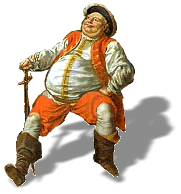
falstaffIn the documentary, Schama presented Shakespeare as writing for both “gents and groundlings”; both cold power-mongers and the “warm, earthy, beer-drinking England” represented by Elizabeth I’s favourite character, Falstaff. After Henry VIII’s reformation divorced him from Catherine of Aragon and England from Rome, Falstaff, says Schama, became “the living embodiment of a small country that suddenly has an outsize sense of itself”.

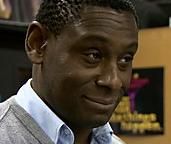
Shakespearian teacher: David HarewoodIn Macbeth, the Movie Star…and Me, Homeland actor David Harewood had five days to prepare pupils from Birmingham’s Washwood Heath Technology College to perform a scene from the Unlucky Play in Stratford-Upon-Avon. It was wonderful to see the kids become Shakespearians not only through Harewood’s tutelage but by the Bard’s living, visceral acquaintance with all of our insecurities. I cried when the actors finally transcended themselves and shone.

Schama, perhaps thinking of today, related that in the 1590s "skyrocketing" living costs sparked riots. Another connection is religious: Shakespeare wrote when "talking about religion could land you in prison, or worse".

Ours times are similar; the uneasy truce between Judaeo-Christian tradition and humanism, whose contradictions birthed modern Western culture, is threatened by sinister forces prepared to silence democracy’s atonal clamour. As the UN tells countries to "undermine national homogeneity" in the name of multiculturalism, programmes like these show that English culture gives everybody a voice. This is the only soil in which true multiculturalism can grow.

Gerry Dorrian
300 words

Click to go to Simon Schama's Shakespeare part 1: This England

Click to go to Macbeth, the Movie Star...and Me with David Harewood

Saturday, 19 May 2012

John Barnes: if race doesn't exist, what's racism?

Former England footballer John Barnes may have a point when he claims that negative images of black people in the last 200 years were generated to give intellectual weight to the slavery industry. Personally, I’m glad we’re coming to accept that race is a chimera.

But there’s been no parallel deconstruction of the notion of racism, still seen as discrimination visited by white people upon others whose skin-colour is different. While there’s enough of that, the concept is open to partisan manipulation by those who feel that being non-white absolves them of becoming what they behold. So we have, for example, Ken Livingstone’s former race advisor Lee Jasper stating that "black people cannot be racist".

This exemption from racism is something that Labour MP Diane Abbott obviously buys into, but it has to be said that there are white people who would like to control what views black people are allowed to hold: thus we saw Rochford and Southend councillor Dr Blaine Robin suspended from the Conservative Party in 2011 for attending an English Defence League demonstration.

Kipling: read about Baa Baa Black Sheep on Britannica Online

One of the writers Barnes has it in for is that shibboleth of the Left, Rudyard Kipling – witness the repeated attacks on his Baa Baa Black Sheep, whose inspiration was not race but his feeling of being treated as "the black sheep" of the family he was living with when attending school in, ironically enough, Southend. But Kipling’s works are complex and nuanced: contrast his pre-emptive attack on multiculturalism in The Stranger at my Gate (quoted in a comment on the Casuals United post on Barnes) with the final stanza of his famous poem on the sacrificial heroism of a Muslim Bhishti water-bearer -

Though I've belted you and flayed you,
By the livin' Gawd that made you,
You're a better man than I am, Gunga Din!

Gerry Dorrian
300 words

Monday, 16 April 2012

government advisor has great idea: breaking news

read more about Charlie Taylor's proposalsCharlie Taylor, the government’s "behaviour tsar", advises that the parents of truanting children should have their child benefit docked. His announcement is great news for three reasons.

Firstly, although truancy exists through the social spectrum, it is most damaging in areas infested by worklessness where child-benefit is most needed. Dcoking it would provide one of the adminstration’s beloved "nudges" to persuade parents to reign their children in.

Secondly, this would recoup money from child benefit minus the leftist message that aspiration is good but achieving that aspiration – even if one earns but a fraction of Tony Blair’s wealth – means you are no longer "one of us", and your children are priveleged. This is precisely the message given by proposals to remove child benefit from higher earners.

Thirdly, the proposal comes from somebody who has walked the walk. Charlie Taylor was headmaster of The Willows School in London for pupils with "behavioural, emotional and social difficulties": in other words, kids whom other schools couldn’t cope with.

Taylor, as a behavioural expert, is presently a government advisor. I hope he runs for election as an MP, in whichever party he chooses, alongside his fellow senior teacher Katharine Brabalsingh (who was suspended by her politically correct head-teacher for daring to question the state-school system).

Plato would have approved of our modern House of Commons, where increasingly MPs study law or politics (rapidly-converging fields) at university then work in either before standing, hence the widening disconnect between the political class and those they purport to represent.

click for Nadine Dorries. blog at ConservativeHomeMinister for Agriculture Jim Paice was a farmer. As an example of somebody who did the task he now oversees, he is increasingly isolated. We need teacher-MPs; fishermen-MPs; nurse-MPs (like Nadine Dorries - left); soldier-MPs; labourer-MPs; and all the rest.

Dare we hope for a revolution of competence in politics?